By Diane, November 21, 2026
Part of our American Preparedness Statistics 2027 report.
A disaster can interrupt more than electricity, transportation, and deliveries. It can also break the ordinary routines that keep people supplied with prescription medicines. A pharmacy may close, roads may flood, a caregiver may not be able to travel, or someone may have to evacuate with little warning. That disruption can turn a routine refill into an urgent problem, and research from Hurricane Florence shows just how fast medication access can become part of a disaster response.
What Happened During Hurricane Florence?
In a 2019 report, the Centers for Disease Control and Prevention looked at hurricane-related emergency department (ED) visits in North Carolina during Hurricane Florence in September 2018. Researchers used the state’s NC DETECT surveillance system and reviewed records from 59 emergency departments. They identified 443 hurricane-related ED visits: 73 before the storm, 185 during it, and 185 after. During the hurricane period, 58 of those 185 visits, or 31%, were for medication refills, a share significantly higher than in the before- and after-storm periods. Medication-refill visits were 2.3 times as common during the hurricane as before it, and 2.3 times as common as after it. Researchers also found that 40 of the 58 refill visits during the hurricane, or 69%, were tied to a disruption of normal services, such as closed pharmacies.
These figures describe one specific event and one specific set of emergency-department visits in North Carolina. They do not mean that 31% of North Carolina residents, or 31% of Americans, ran out of medication. The study did not survey all residents or measure how many households kept an emergency supply. It examined hurricane-related ED visits that met the study’s case definition.
Why a Pharmacy Closure Can Become a Health Problem
Most people get their medicines through a routine chain: a prescription is written, a pharmacy fills it, insurance or payment goes through, and the patient picks it up. A disaster can snap several of those links at once. A pharmacy may be closed or unreachable. Roads may be blocked. A person may be staying somewhere other than home. A caregiver may be separated from the person who needs the medicine. Even an open pharmacy can be hampered by its own supply, phone service, or electronic systems. The Florence findings show one result of that broken chain: some people turned to emergency departments for refills when normal services were disrupted. Emergency departments are essential for urgent care, but they are not a dependable stand-in for a household medication-continuity plan.
Start With a Medication Record
A current medication list is one of the simplest and most useful things you can prepare. It helps a caregiver, pharmacist, or clinician understand what a person normally takes when the usual routine is interrupted. Keep a paper copy with your emergency documents and a secure digital copy you can reach when you need it. A good list includes:
- Medication name, including the generic name when you know it.
- Strength and prescribed dose.
- How often it is taken and the usual schedule.
- The condition or purpose it treats, where that helps.
- Prescribing clinician and contact information.
- Pharmacy name, address, and phone number.
- Known medication allergies and important reactions.
- Related supplies, equipment, or storage requirements.
Update the list whenever a prescription changes. Do not rely only on a photo of the pill bottles: labels get damaged, bottles get separated from their contents, and a person may take medicines from several containers.
Ask About Emergency Supplies Before a Storm
Do not wait until a storm is bearing down to ask how to keep your prescriptions coming. Talk with a pharmacist or prescribing clinician ahead of time about whether an emergency supply makes sense for you, how early a refill can be requested, and what to do if a pharmacy closes. Emergency-refill rules vary by state, by medication type, and by circumstance. Some states let pharmacists provide limited emergency refills under defined conditions, but that does not mean every prescription can be refilled early in every situation. Ask your pharmacist how the rules apply to your medicines, and check current state guidance. The CDC recommends discussing an emergency medicine supply with a doctor or pharmacist, and the FDA advises people to know how much medicine they have, keep prescription copies with their emergency supplies, and get early refills when access may be disrupted.
Plan for Medicines That Need Refrigeration
Some medicines have to stay within a specific temperature range. Insulin and certain liquid medicines are examples, but storage requirements differ by product, and a refrigerator outage does not create one universal rule for every medicine. Check the product’s storage instructions before an emergency. Ask the pharmacist or manufacturer what temperature range is acceptable, how long the medicine can sit outside that range, and what to do if the power goes out. Keep a cooler and suitable cold packs on hand if your pharmacist recommends them, but do not let a medicine freeze unless its instructions specifically allow it. If refrigeration is interrupted, do not guess whether a medicine is still usable. Check the label and contact a pharmacist, health care professional, or manufacturer for product-specific advice. The FDA notes that medicines exposed to excessive heat or floodwater may be unsafe or less effective, and medicine contaminated by floodwater should not be used.
Keep Medicines Protected From Water and Evacuation Delays
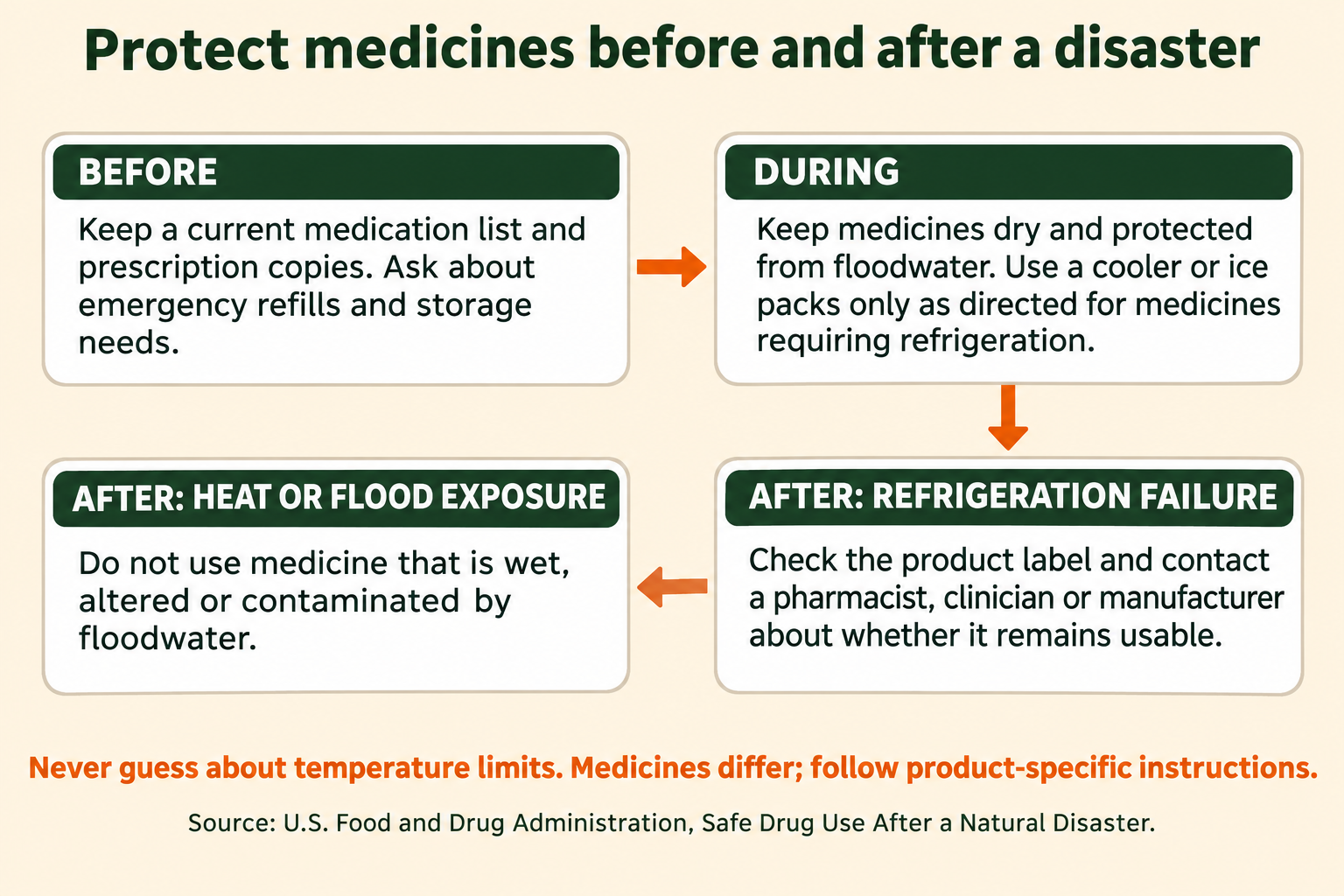
Floodwater can carry sewage, chemicals, and other contaminants, so store medicines in a watertight container and keep them above likely flood levels. Keep essential medicines where you can grab them quickly if you have to evacuate. If you do evacuate, take your prescription medicines with you rather than leaving them in a home that could be inaccessible for days, and bring the medication list, prescription copies, pharmacy contacts, and any supplies you need. If you depend on a caregiver, agree in advance on who carries the medicines and who can help if you get separated.
A Practical Medication Continuity Plan
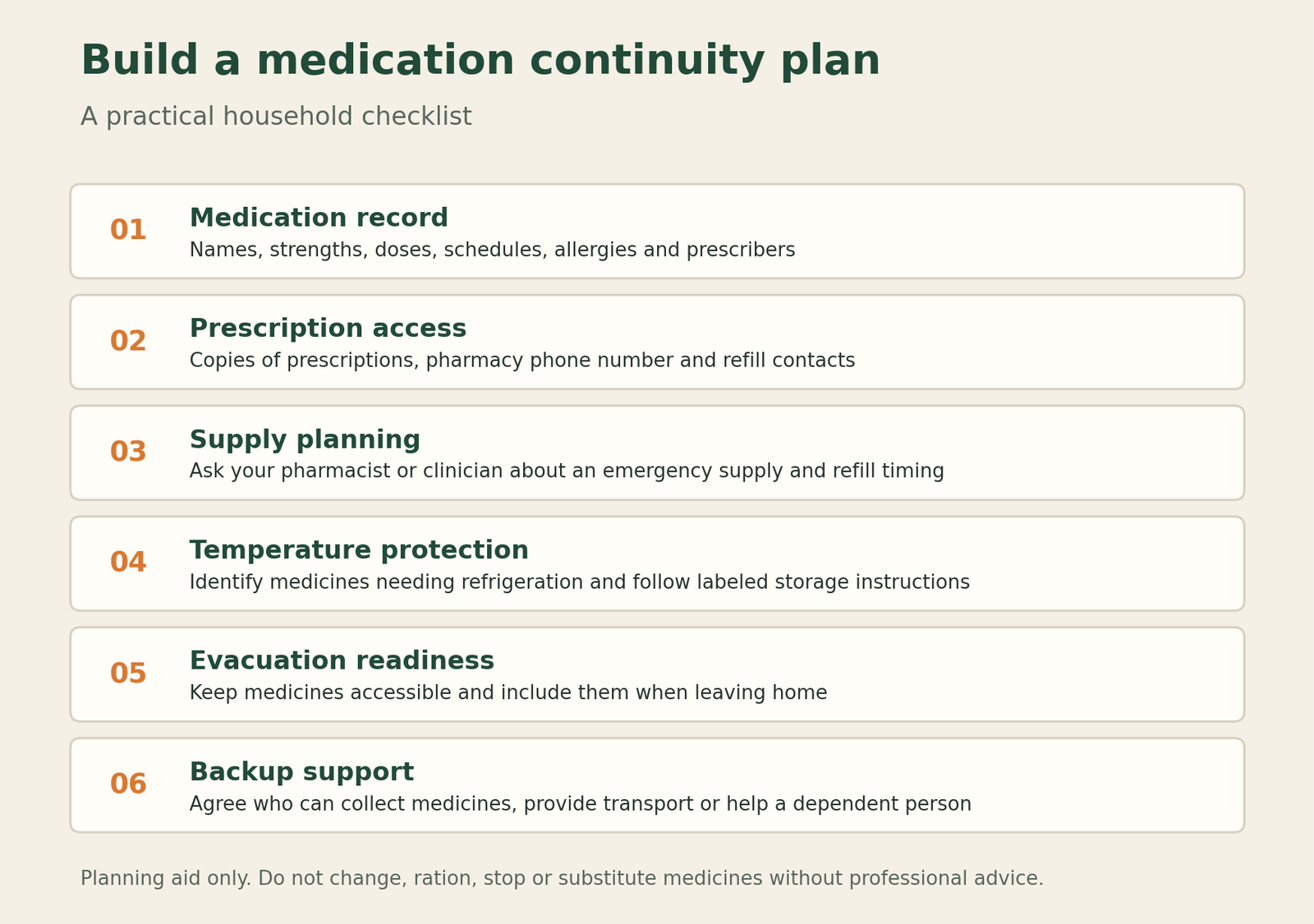
- Make a complete medication list and update it whenever a prescription changes.
- Keep copies of prescriptions and pharmacy contact information with your emergency documents.
- Ask your pharmacist or clinician about emergency supplies, early refills, and state emergency-refill rules.
- Identify medicines that need refrigeration or other special storage, and get product-specific instructions.
- Store medicines in a dry, secure place protected from likely floodwater.
- Keep essential medicines and supplies where you can take them during an evacuation.
- Choose a backup person who can help collect prescriptions or provide transportation.
- After a disaster, check medicines for water damage, heat exposure, or storage problems, and ask a pharmacist before using anything questionable.
What If You Cannot Reach Your Usual Pharmacy?
Before an emergency, ask your pharmacy how it handles closures and whether it can transfer prescriptions to another location when that is permitted. Keep the pharmacy’s phone number and your prescription information handy. If you are displaced, ask local health officials, your insurer, pharmacist, or clinician about legitimate ways to get the medication you need. Do not assume that every pharmacy can see another pharmacy’s records, or that every prescription can be transferred. Controlled substances and some other medicines carry additional legal restrictions, and a pharmacist can explain what options exist for a particular prescription.
What the Florence Study Does and Does Not Tell Us
The study is valuable because it documents a real disruption pathway: closed pharmacies and interrupted services were tied to many of the medication-refill ED visits during Hurricane Florence. It also shows why medication planning belongs in household disaster preparedness, not only in routine health care. But it has limits. It covers one hurricane, one state, and a defined set of emergency-department visits. It does not estimate the share of households that ran out of medicine, compare everyone who had a refill problem with those who did not seek emergency care, or establish how many ED visits a larger home supply could have prevented. Use the findings as a case study, not a national prevalence statistic.
Make Medication Access Part of the Household Plan
A medication plan does not need to be complicated. It needs to be current, accessible, and realistic for the people who depend on it. A list of prescriptions, a conversation with the pharmacist, a plan for temperature-sensitive medicines, and a clear evacuation routine can keep a disruption from turning into a medication emergency. The best time to make those arrangements is before the next warning, outage, or evacuation order, not when the pharmacy is already closed.
More From the Preparedness Report
- Power Outages and Medical Preparedness
- Why Older Adults Face Different Preparedness Challenges
- Understanding the Preparedness Gap
Related tool: Build your household kit, medications included, with our Emergency Kit Builder.
Sources and Further Reading
- CDC. Notes from the Field: Hurricane Florence-Related Emergency Department Visits, North Carolina, 2018 (MMWR, July 19, 2019).
- CDC. Prescriptions: Prepare Your Health (April 18, 2024).
- FDA. Safe Drug Use After a Natural Disaster.
- CDC. Refrigerated Drugs: Natural Disasters (August 26, 2026).
- CDC. Hurricanes and Prescription Medications (August 25, 2026).
- FDA. Hurricane Season: Be Prepared.