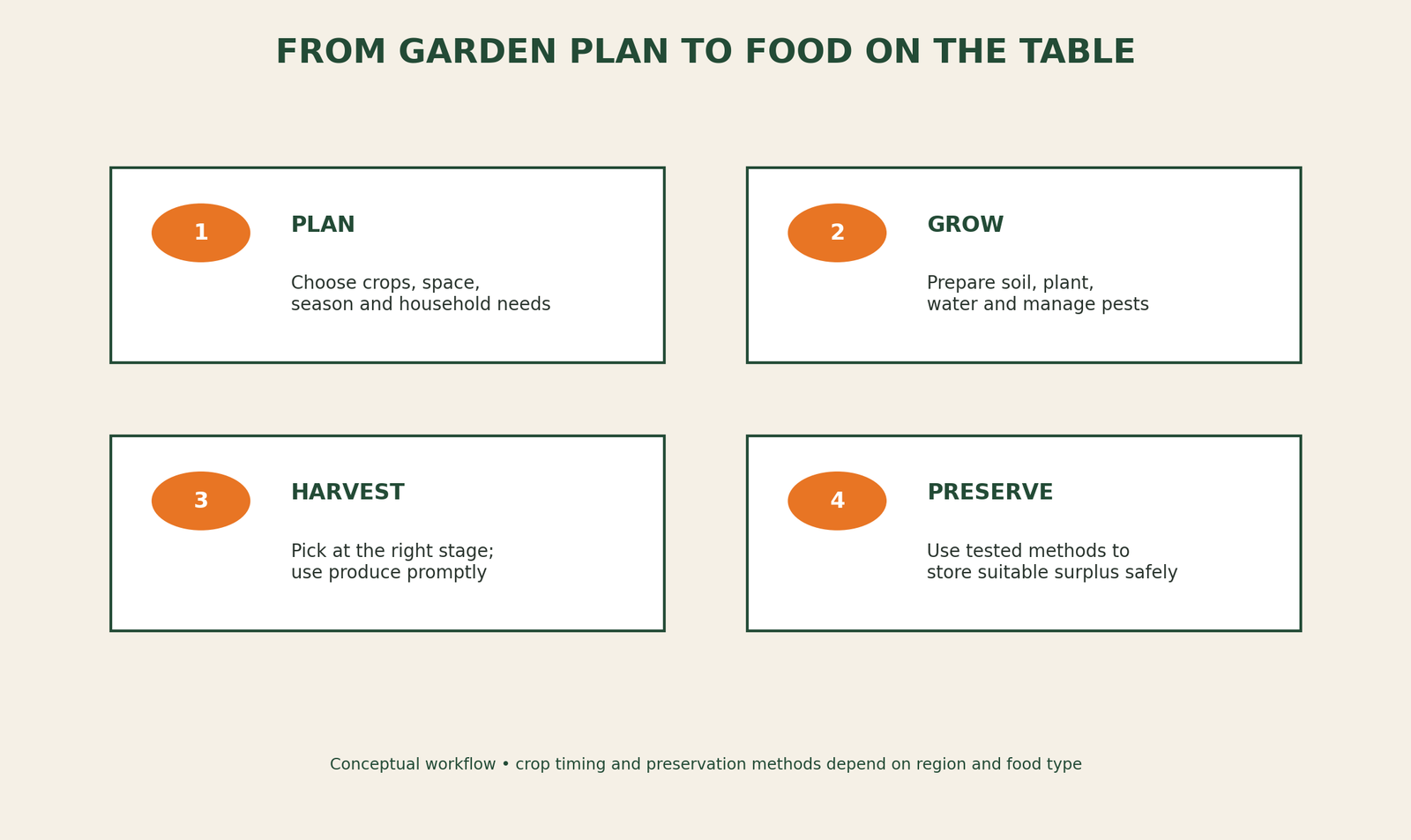
By Diane, November 21, 2026
Part of our American Preparedness Statistics 2027 report.
A home garden can put fresh vegetables, herbs, and fruit on your table. It can also teach practical skills, give your household another source of food, and let you preserve part of a harvest for later. But how much can a garden really do when grocery access, prices, or normal food distribution get disrupted?
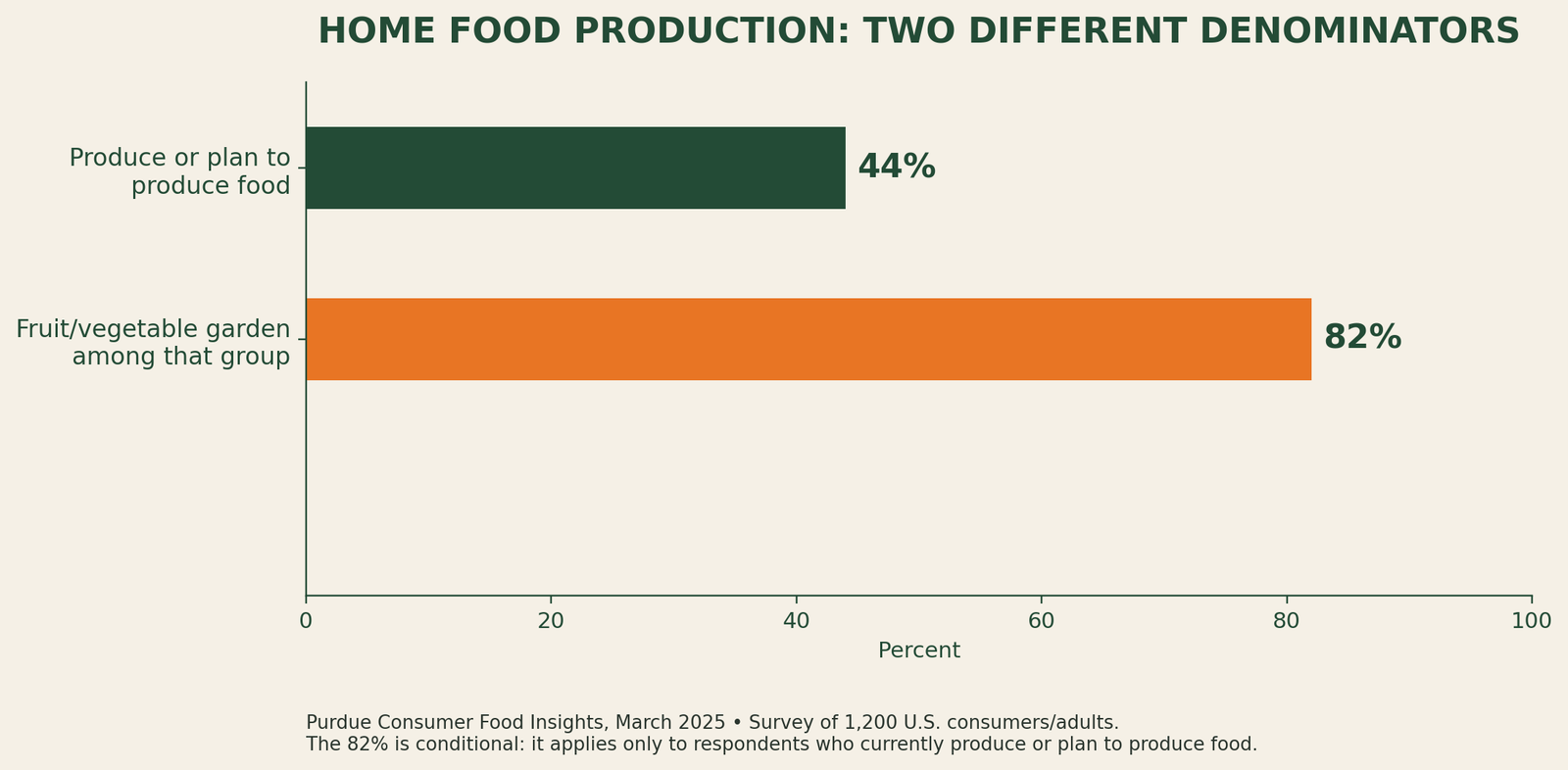
The honest answer is that it depends. A few containers can add useful fresh produce to meals. A larger, well-managed garden can bring in a substantial seasonal harvest. Neither one tells you how many weeks of food a household can supply from its own land, because that comes down to what you grow, how much you harvest, how much you eat, and whether the food can be stored safely. A March 2025 survey from Purdue University gives us a useful look at the interest in home food production. It found that 44% of households currently produce or plan to produce some of their own food, and among that group, 82% named fruit and vegetable gardening as something they do or plan to do. Those are participation findings, not measurements of harvest size, calories, or self-sufficiency.
For preparedness, the most useful way to think about a garden is as one part of a broader food-continuity plan. It diversifies your food sources and builds real skills, and it works best alongside stored food, normal shopping when it is available, safe preservation, and community resources. I garden in Arkansas myself, so none of this is theory to me; it is just how a resilient pantry actually comes together.
What the Research Says About Growing Food at Home
Purdue University’s Center for Food Demand Analysis and Sustainability put home-food-production questions into its March 2025 Consumer Food Insights survey, which polled more than 1,200 American adults from across the country. Purdue’s April 9, 2025 news release summarized the results. The survey found that 44% of households said they currently produce or plan to produce their own food, and vegetable and fruit gardening was the most popular activity at 82%, among the respondents in that current-or-planned group.
The denominator matters here. That 82% does not mean 82% of all U.S. households have a vegetable garden. It refers only to the group that currently produces or plans to produce food, and because the survey let people pick more than one activity, those categories are not mutually exclusive. It is worth being clear about what the figures do and do not say: Purdue measured reported participation and plans. It did not measure how many pounds of food were harvested, how much money households saved, what share of a household’s food came from the garden, or how long a harvest could feed a family.
Why Households Are Interested in Producing Food
The survey landed during a stretch when many people were worried about grocery prices. In that same March 2025 survey, 84% described grocery prices in their area as high to some degree. That context helps explain why the researchers asked about home food production, but it does not prove that prices sent people out to the garden. The survey also found a split in why rural and urban households said they grow food: more than 40% of rural households picked food security and preparedness as a primary reason, compared with 20% of urban households. That is a reported-motivation difference in one survey, not proof that rural households produce more food or are better prepared.
Home food production can serve several purposes at once: fresh ingredients, enjoyment, learning, managing cost, food security, and preparedness. You might start for one reason and get several benefits. It is also fair to say that gardening takes inputs, space, water, time, tools, seed, soil, and know-how, and those are not equally available to everyone.
A Garden Can Help, but It Is Not a Replacement for the Food System
A garden adds another source of food, which is genuinely valuable. It does not automatically replace the grocery store, the farms, the processors, the transportation, the refrigeration, or the community distribution behind them. Most home gardens focus on fresh produce. That produce brings vitamins, minerals, fiber, and variety to your meals, but most households still lean on purchased staples to meet their full dietary needs. How much the garden contributes shifts with its size, the crops you choose, the growing season, weather, soil, water, labor, and how your household eats.
Picture two gardens. Someone growing tomatoes and herbs in containers may have fresh ingredients all season and still see little change in the household’s overall food supply. A family with a larger vegetable plot may harvest enough of certain crops to eat fresh, share, and preserve. Neither one earns a universal “number of meals” or “days of food” without measuring the actual harvest and how the household uses it.
What Determines How Much Food a Garden Can Produce?
Available Space and Growing Method
A garden does not have to start as a big plot. Containers, raised beds, in-ground rows, and vertical supports each come with their own possibilities and limits, and the best choice depends on sunlight, water access, soil, mobility, budget, and the crops you pick. Small spaces usually pay off best with crops that give repeated harvests or a good amount of produce for the room they take. Larger areas allow more variety and volume, but they also demand more preparation, maintenance, and water. Do not assume a small garden supplies a fixed percentage of your food.
Season and Climate
Vegetables do not all grow at the same time of year. Cool-season crops struggle in summer heat, while warm-season crops need enough frost-free time to mature, and a garden planted at the wrong time can produce poorly even with good care. In Arkansas, the University of Arkansas System Division of Agriculture Cooperative Extension publishes separate spring and summer and fall planting calendars, and it stresses adjusting the dates to your climate zone within the state. That is a good example of why planting calendars should be local rather than copied from a national list. Succession planting stretches the harvest of short-window crops: instead of putting in a whole row at once, make several smaller plantings at the intervals recommended for the crop and region. Extension guidance also notes that transplants can help some crops mature before the worst heat or cold arrives.
Water and Soil
A reliable water source is essential. Drought, watering restrictions, a failed well pump, or a power outage that stops irrigation can all cut production. Soil quality, drainage, organic matter, and nutrient availability shape growth too. Soil testing and regionally appropriate amendments do far more good than adding fertilizer or compost without knowing what the soil actually needs.
Labor, Tools, and Ongoing Maintenance
Planting is just the start. A productive garden needs time for watering, weeding, mulching, pruning or trellising, watching for insects and disease, harvesting, and cleanup. Choose a size you can keep up with during busy stretches, illness, hot weather, or other disruptions. A smaller garden you water and harvest consistently will usually serve you better than a big plot that gets away from you or produces more than you can use.
Pests, Disease, and Weather
Insects, plant diseases, extreme heat, heavy rain, hail, and surprise freezes can damage crops or cut a harvest short. Crop selection, resistant varieties, rotation, spacing, mulching, sanitation, and regular observation reduce some of that risk, but no garden is immune to every problem. The University of Arkansas Extension recommends practices such as proper plant spacing, supporting crops with cages or trellises, managing weeds, and keeping soil moisture steady. Those are production practices, not guarantees of a particular yield.
Plan the Garden Around the Food Your Household Actually Uses
A preparedness garden should be built around your meals and your household’s tastes, not just around what looks tempting in a seed catalog. If nobody eats a certain vegetable, a big harvest won’t strengthen your food security. Start with foods you already buy and eat, then think about which crops are practical in your climate, how much space they need, when they mature, and whether you can use them fresh or preserve them.
- List the vegetables, fruits, and herbs your household eats regularly.
- Choose a manageable number of crops for the first season instead of planting everything at once.
- Check local planting dates and days to maturity before buying seed or transplants.
- Match crops to the sunlight, soil, water, and space you actually have.
- Include crops with different harvest windows so everything does not come ripe at once.
- Plan how you will use, share, or preserve produce before the harvest outgrows your needs.
Preserving the Harvest Extends Its Usefulness
Fresh produce is perishable, and a garden can hand you more of a crop in a short window than you can eat before it spoils. Preservation carries some of that harvest into later months, but it brings its own equipment, storage, and safety demands. Freezing, drying, and canning are the common methods, and they are not interchangeable; the right one depends on the food, its acidity, the equipment you have, and your storage conditions. For home canning, use tested recipes and validated processing methods from an authoritative source such as the National Center for Home Food Preservation. Do not improvise processing times, pressure levels, or ingredient changes.
Preservation also leans on utilities and supplies. Freezing needs reliable freezer temperature and electricity. Drying needs suitable equipment or conditions and careful storage. Canning needs the correct jars, lids, equipment, and a tested processing method. Think those dependencies through before you count preserved food as part of your emergency supply.
How Home Food Production Fits Into Household Preparedness
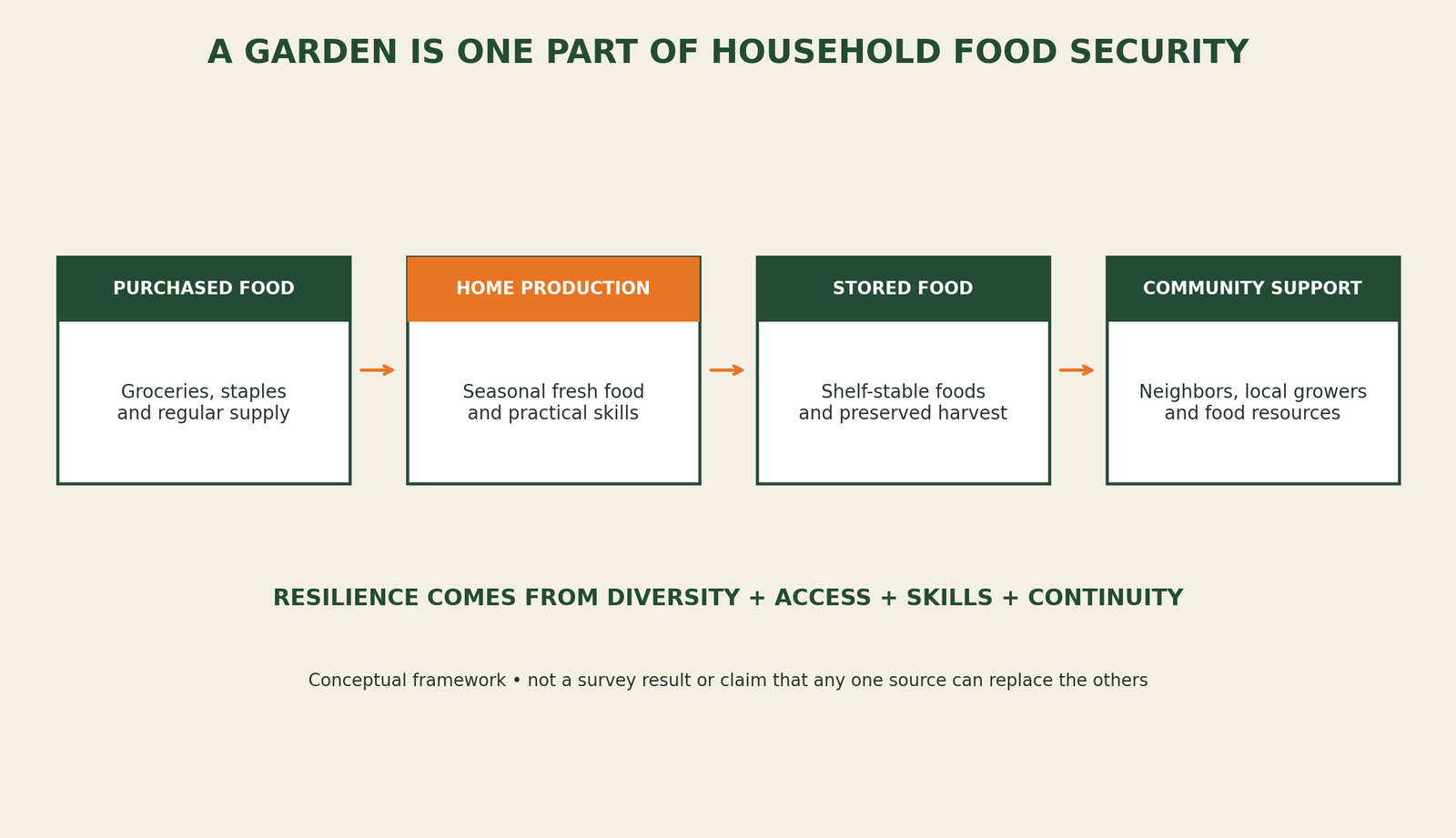
The most resilient approach combines several sources instead of leaning on one. A garden provides seasonal fresh food. Stored food covers the gaps between harvests. Normal shopping supplies what is hard or impractical to grow. Community networks help households trade information, tools, or surplus produce. A food plan should also account for what happens if water, electricity, fuel, or transportation is interrupted, because some stored foods need cooking or added water, a garden needs irrigation, frozen produce needs power, and a canning project needs safe equipment and tested instructions. Thinking those connections through keeps you from mistaking one resource for a complete solution.
What the Research Still Does Not Tell Us
The Purdue Consumer Food Insights findings give a useful snapshot of reported participation and intentions. They do not tell us how many pounds of food households produce, how much of a grocery bill gets replaced, how many calories come from home production, or how long a garden could feed a household. Those questions need different research: measured harvest weights, crop types, household size, food actually eaten or preserved, losses, growing duration, and the share of household food supplied. Without that, turning participation percentages into a national contribution or a food-duration figure would be misleading. The same caution goes for preparedness. Having a garden, or planning one, does not establish that a household can hold its food access through a disruption. That capability depends on whether the garden produces, whether you can harvest and use the food, and whether your other essential resources hold up.
Start Small, Learn What Works, and Build From There
Home food production can strengthen your household’s food security by adding another source of fresh food, building practical skills, and opening the door to preserving seasonal harvests. The size of that contribution will vary, and that is no reason to dismiss it. Choose a garden that fits your space, climate, water supply, and time. Grow foods people actually eat. Learn your local planting calendar, keep records of what produces well, and preserve the surplus with safe, tested methods. A garden is not a substitute for the whole food system. It is one useful part of a broader plan that combines stored food, shopping options, practical knowledge, and community support.
More From the Preparedness Report
- How Much Emergency Water Should You Store?
- How to Prepare Your Pets for a Disaster
- How to Prepare for a Two-Week Power Outage
Related tool: Planning what to plant? Our Seed Starting Calculator shows when to start each seed for your area.
Sources and Further Reading
- Purdue University, Center for Food Demand Analysis and Sustainability. Consumer Food Insights, Volume 4, Issue 3: March 2025. Survey of more than 1,200 American adults, including the home food production questions and urban/rural analysis.
- Koppes, S. (April 9, 2025). “Many consumers report high grocery prices; more households plan to produce their own food.” Purdue University College of Agriculture.
- University of Arkansas System Division of Agriculture, Cooperative Extension Service. “Planting and Maintaining a Vegetable Garden.”
- University of Arkansas System Division of Agriculture, Cooperative Extension Service. “Planning a Vegetable Garden in Arkansas.”
- University of Arkansas System Division of Agriculture, Cooperative Extension Service. “Planting Dates for Spring and Summer Vegetable Production.”
- University of Arkansas System Division of Agriculture, Cooperative Extension Service. “Planting Dates for Fall Vegetable Production.”
- National Center for Home Food Preservation. Tested home food preservation guidance and recipes.