By Diane, November 21, 2026
Part of our American Preparedness Statistics 2027 report.
For most of us, a pet is family. But when an evacuation order comes through, an animal turns a plan into a longer checklist: carriers, leashes, food, medication, veterinary records, a ride, and somewhere safe to land. The hard part is rarely deciding whether to bring your pet. The hard part is being able to actually move every animal, keep them secure, and meet their needs if normal services are down for several days. That is what we are going to work through here.
What the ASPCA Survey Tells Us About Pet Preparedness
A 2021 ASPCA survey of U.S. pet owners found that 83% reported living in a community that faces natural disasters. Yet only 46% said they had a disaster preparedness plan in place. More than 90% said they would bring their pets with them during an evacuation, while 84% had not secured emergency pet-friendly housing.
The survey also found that more than one in five pet owners had evacuated their homes because of a disaster or emergency. Nearly half of pet-owning evacuees had left at least one pet behind. Among those who left a pet, nearly 30% said they did not have enough time when the disaster struck.
It is worth slowing down on those numbers, because they measure different things and come from different groups. The 46% plan figure is among all pet owners. The finding about leaving an animal behind applies only to pet owners who actually evacuated. And the more-than-90% figure measures what people say they intend to do, not proof that a household has the transportation, carriers, and accepting destination to make it happen. These are 2021 results, so treat them as a snapshot from that year, not a current 2026 or 2027 estimate.
Why Good Intentions Are Not Enough
You can fully intend to evacuate with your dog or cat and still not pull it off quickly. The carrier is buried in a closet. The cat will not be handled. There are more animals than carriers. The first hotel you call does not take pets. Or you are at work when the order comes, and someone else has to get the animals out. Any one of those can stall a good plan at the worst moment.
A plan that holds up connects four pieces: identification, transport, supplies, and a destination. If one is missing, the whole thing can fall apart. The reason to settle these details now is simple: every decision you make in advance is one you will not have to make under pressure, in the dark, with a storm coming.
Build a Pet Emergency Kit
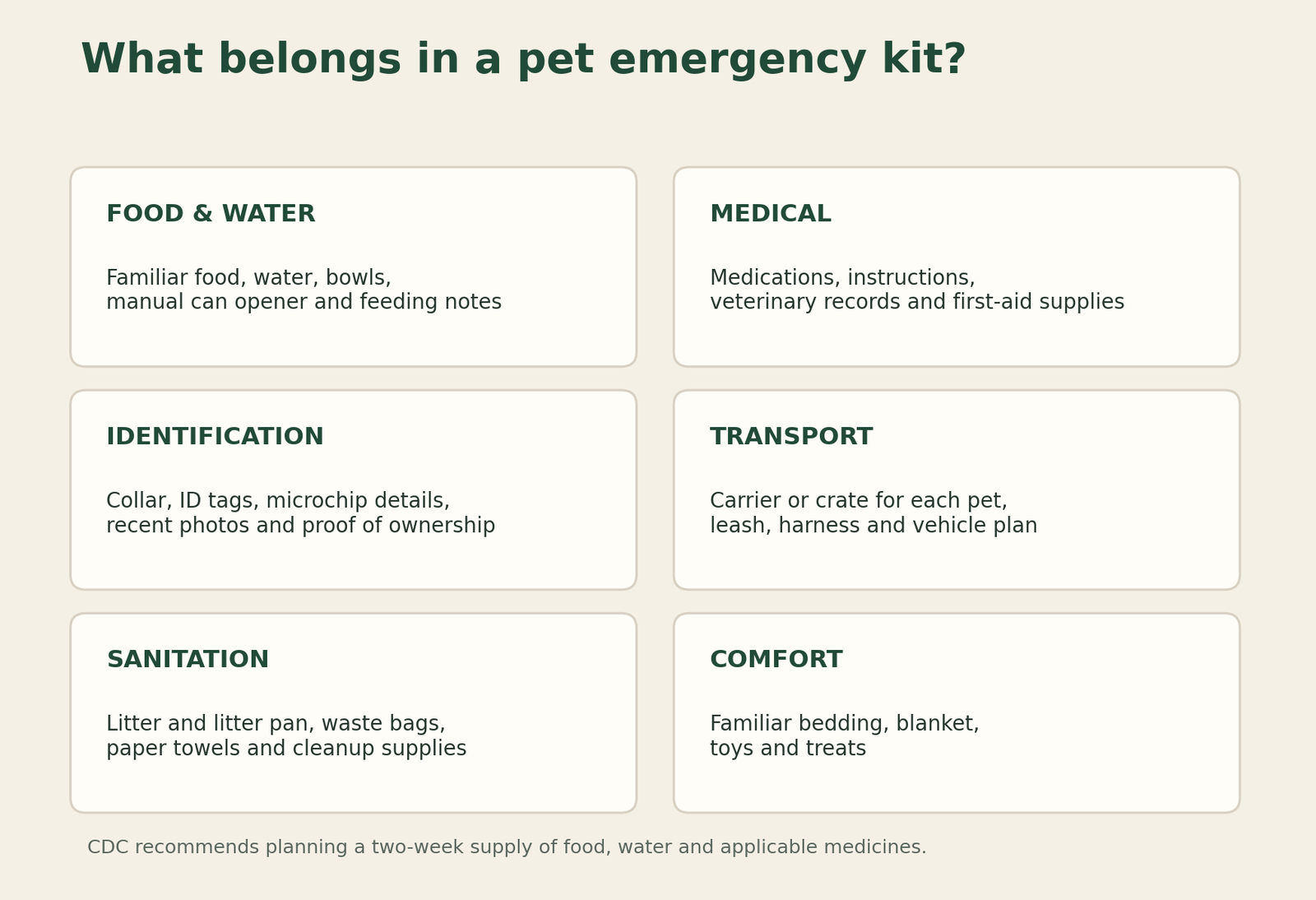
The CDC recommends preparing a pet disaster kit and asking your veterinarian what belongs in it. Its checklist includes a two-week supply of food and water for each animal and, where it applies, a two-week supply of medication. The AVMA’s evacuation-kit guidance lists different minimum quantities for some items, so do not treat every suggested number as interchangeable. Follow the current guidance that fits your situation, and ask your vet about anything specific to your animal.
Food, Water, and Feeding Supplies
- Store familiar food. Keep it in waterproof containers and rotate it before it expires. A sudden food change can upset an animal’s digestion at exactly the wrong time.
- Keep water for each pet. Set aside water specifically for the animals, along with bowls that are easy to carry and clean.
- Write down feeding instructions. This matters most if someone else may end up caring for the animal.
- Pack a manual can opener if your animal eats canned food.
Medication and Veterinary Information
- Pack current medications with written instructions, and ask your veterinarian how to keep an adequate supply on hand.
- Keep copies of records: vaccination records, rabies certificates, medical summaries, and prescriptions.
- Include contacts. Your veterinarian’s information, plus an emergency veterinary contact if you have one.
- Note special needs. Write down any special handling, feeding, or medical requirements.
Identification and Ownership Records
- Use current ID tags on a collar where that is appropriate for the animal.
- Keep the microchip details handy. Have the microchip number and the registry’s contact information accessible, and make sure your registration is current.
- Store recent photos. Clear shots of each animal, including identifying features. A photo of you with your pet helps establish ownership.
- Protect the paperwork. Keep adoption, registration, or ownership records in a waterproof pouch and a secure digital location.
Transport, Sanitation, and Comfort
- One carrier per animal that needs one, sized correctly and labeled with your contact information.
- Keep leashes and harnesses together, along with spare identification equipment.
- Pack the cleanup supplies: litter and a litter pan for cats, waste bags for dogs, paper towels, and general cleanup items.
- Bring comfort items. Familiar bedding, a blanket, toys, or treats to take the edge off the stress.
Choose Destinations Before You Need Them
Do not assume that every emergency shelter, hotel, or temporary housing site will take animals. Call your local emergency management office and ask how pet sheltering is handled where you live. Then line up more than one possible destination outside the hazard area, so you are not down to a single option that falls through.
- Family or friends who can take your animals.
- Pet-friendly hotels along the routes you would likely use.
- Boarding facilities or veterinary clinics that may accept animals during an emergency.
- Local animal shelters or emergency pet-sheltering arrangements coordinated by officials.
When you call, ask about the limits: species, number of animals, carrier requirements, vaccination records, and whether they can take an animal with medical or behavioral needs. Policies can change during a disaster, which is exactly why you want a second and third option already in your pocket.
Practice Getting Every Animal Into the Vehicle
A plan you have never run can take far longer than you expect. Help your pets get comfortable with their carriers before anything happens. Practice loading them into the vehicle, securing the carriers, and taking a short trip. Keep leashes and carriers somewhere you can reach them fast, not at the back of a closet.
If you have several pets, assign each animal to a person and a carrier ahead of time. Decide who collects the animals if the adults are at work or the kids are at school. Arrange with a trusted neighbor or nearby contact to step in if you cannot get home, leave written instructions, and make sure that helper knows where the kit is stored.
If You Have to Shelter at Home
Not every emergency means leaving. If officials tell you to shelter in place, bring your pets indoors and keep them in a secure, pet-friendly room away from hazards, with food, water, medications, carriers, and litter or waste supplies on hand. Keep animals from wandering outdoors in a damaged area. Familiar landmarks and scents may have changed, and a frightened animal can get lost quickly.
Special Considerations for Different Animals
Dogs and Cats
Dogs and cats usually need a secure carrier or leash, familiar food, water, identification, sanitation supplies, and veterinary records. Cats tend to hide when they are scared, so know where yours retreats to and keep a carrier within reach. Dogs should have a secure leash and a properly fitted collar or harness.
Birds, Reptiles, and Small Mammals
These animals often have specialized temperature, humidity, lighting, ventilation, and handling needs. Ask an exotic-animal veterinarian what transport container and backup supplies make sense, and do not assume a standard dog-and-cat kit will cover them. Plan for safe temperature control and secure containment while you are on the move.
Horses and Livestock
Large animals are a different level of planning. Identify trailers, vehicles, experienced handlers, and routes well in advance, and confirm that your destination has suitable fencing, feed, water, veterinary support, and handling equipment. If you own livestock, coordinate with local emergency management and your agricultural extension or animal-health authorities about evacuation and shelter options before you need them.
A Simple Pet Disaster Plan to Complete Now
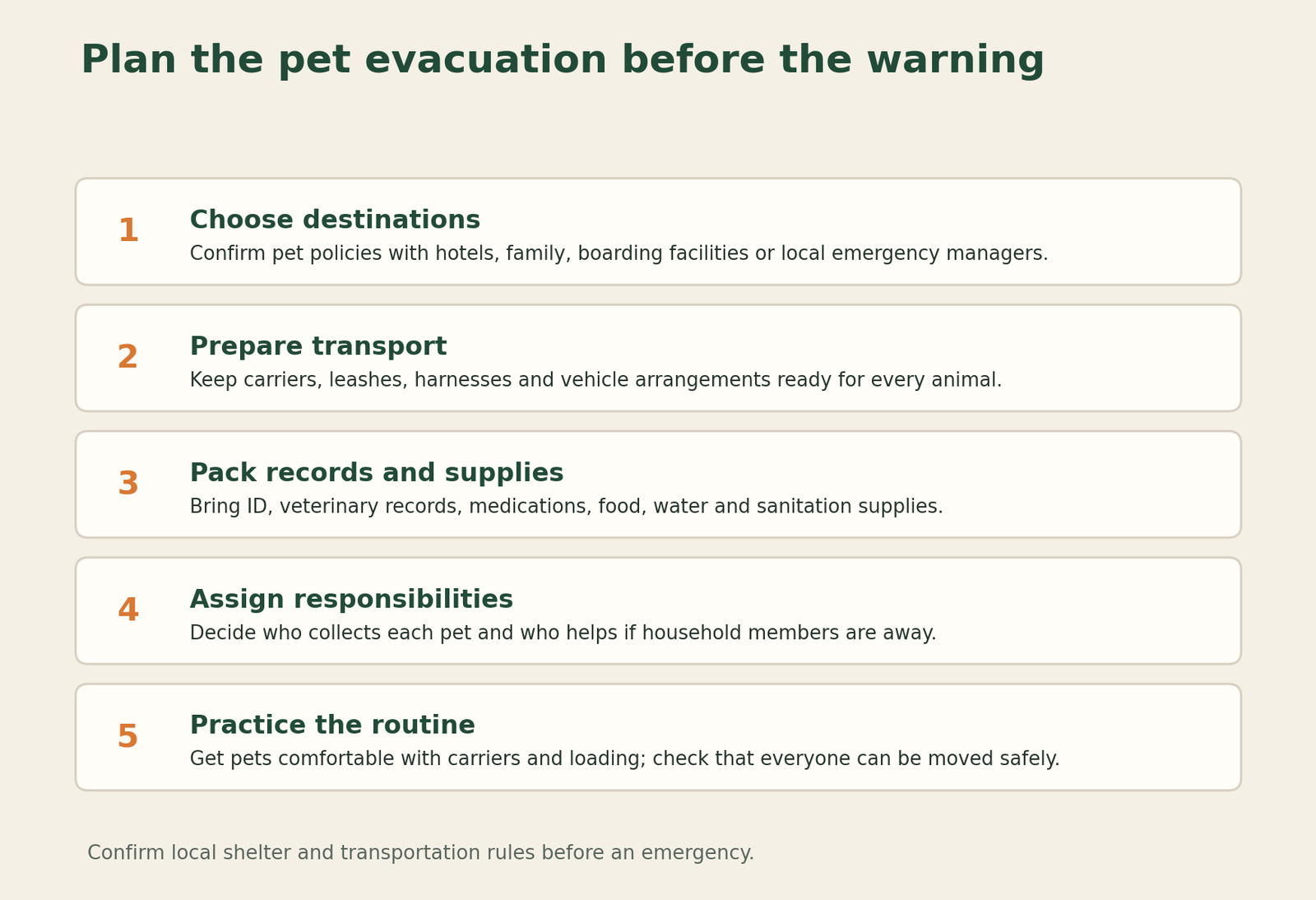
- List every animal in the household, including identifying details and special needs.
- Update microchip registration, ID tags, and veterinary records.
- Pack food, water, medication, carriers, sanitation supplies, and comfort items.
- Choose at least two destinations that can accept your animals.
- Assign who collects each animal, and who helps if the household is away.
- Practice loading and transporting every animal.
- Review supplies and records at least twice a year, and after any change in medication, diet, or household circumstances.
What the Research Does Not Tell Us
The ASPCA survey points to a real gap between what pet owners intend to do and the arrangements they have actually made. What it does not say is that every owner without a formal plan will leave an animal behind, or that every plan would work smoothly under real evacuation conditions. It is a useful national snapshot from 2021, not a measure of how households are behaving right now.
The practical takeaway is straightforward: plan for your animals in the same breath as you plan for the people. For a pet-owning household, an evacuation plan is not finished until every animal has a way to travel, a place to go, and the supplies to stay safe once you get there.
More From the Preparedness Report
- Why Older Adults Face Different Preparedness Challenges
- Safe Room vs. Storm Shelter vs. Bunker
- Growing Food for Household Security
Related reading: How Much Dog Food to Pack for a 3-Day Evacuation and What Goes in a Dog First Aid Kit.
Sources and Further Reading
- ASPCA, New Survey Reveals 83 Percent of Pet Owners Live in an Area Impacted by Disasters, Yet Less Than Half Have a Preparedness Plan in Place (September 13, 2021).
- CDC, Build a Pet Disaster Preparedness Kit (April 9, 2024).
- CDC, Be Prepared: Pet Safety in Emergencies.
- American Veterinary Medical Association, Pets and Disasters.
- FEMA, Are You Petpared for Disasters?
- SAMHSA and AVMA, Save the Whole Family: Disaster Preparedness for Households With Pets.