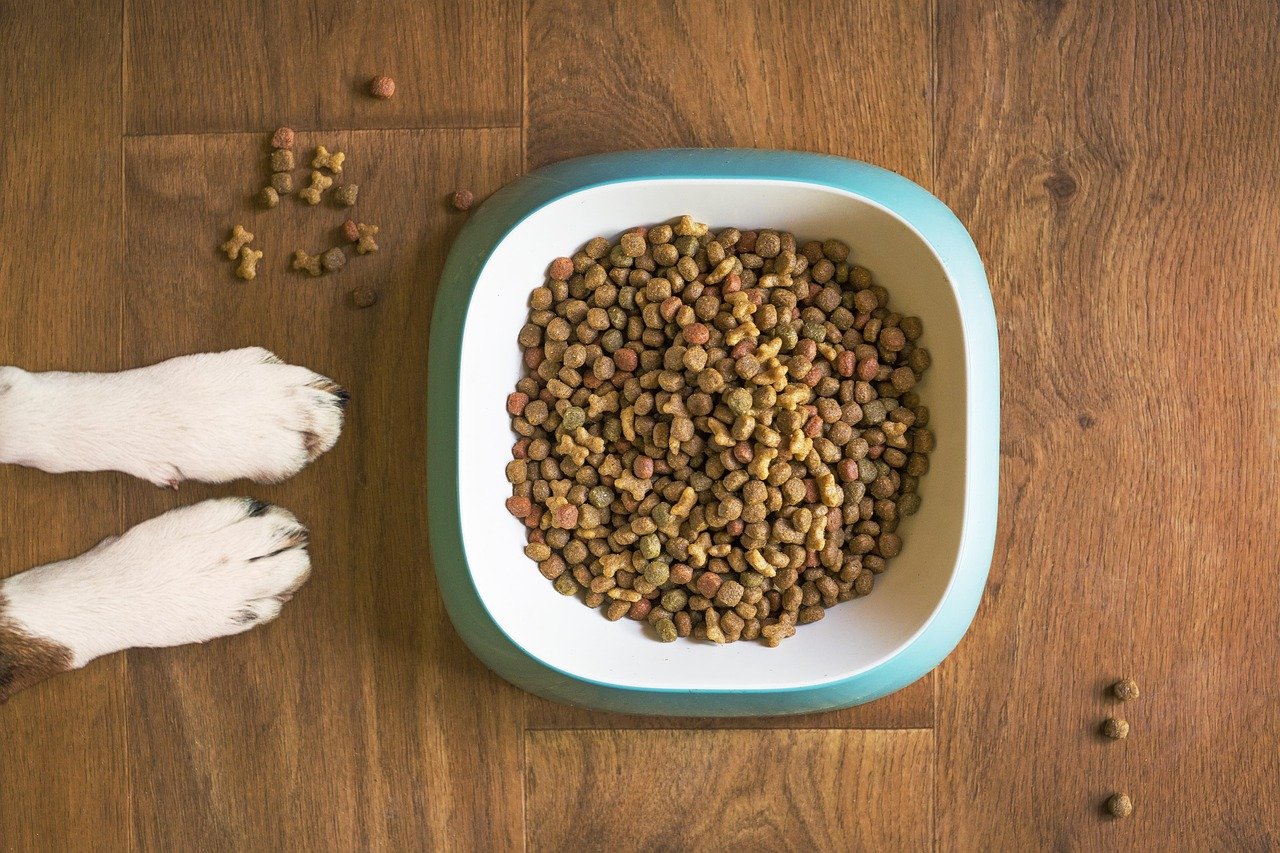
A familiar food tub can hide a one-day shortage.
The leash and medications are by the door, but the dog-food container is only half full. In a rushed evacuation, there may be no time to check whether that amount will last until the third morning. Measure from the dog’s usual daily ration, not from how full the container looks or the serving suggestion on the bag.
Multiply that daily amount by three, then portion it into labeled meals or mark the total on a sealed container. This makes the supply easy to verify and helps anyone feeding the dog avoid using too much on the first day. Keep it with the pet emergency kit checklist supplies so food is ready to grab alongside the leash and medications.
Measure each dog’s daily ration
Package feeding charts are estimates, not a record of what a dog eats. Measure each dog’s usual meals with a kitchen scale or a marked measuring cup. Note food that is routinely left behind: the amount poured into a bowl may be more than the dog’s actual daily intake.
Record the brand and exact formula, meal size, and number of meals per day for each dog. Keep dry food in its measured unit, such as grams or cups; note wet food in cans, pouches, or fractions of a container. If a dog eats both, list each food separately rather than combining them into one portion.
Include any prescription diet and food regularly given with medication, such as a spoonful of wet food needed to deliver a pill. Check whether that spoonful comes from a regular meal or is extra, so it is not counted twice. A prescription formula should be recorded by its full name; a similar-looking product may not serve the same medical purpose.
Multiply each meal portion by its daily frequency, then calculate each dog’s total separately. For example, 90 grams of kibble twice daily equals 180 grams per day, or 540 grams for three days. Separate records prevent a larger dog’s ration from obscuring a smaller dog’s needs.
Calculate three days of food
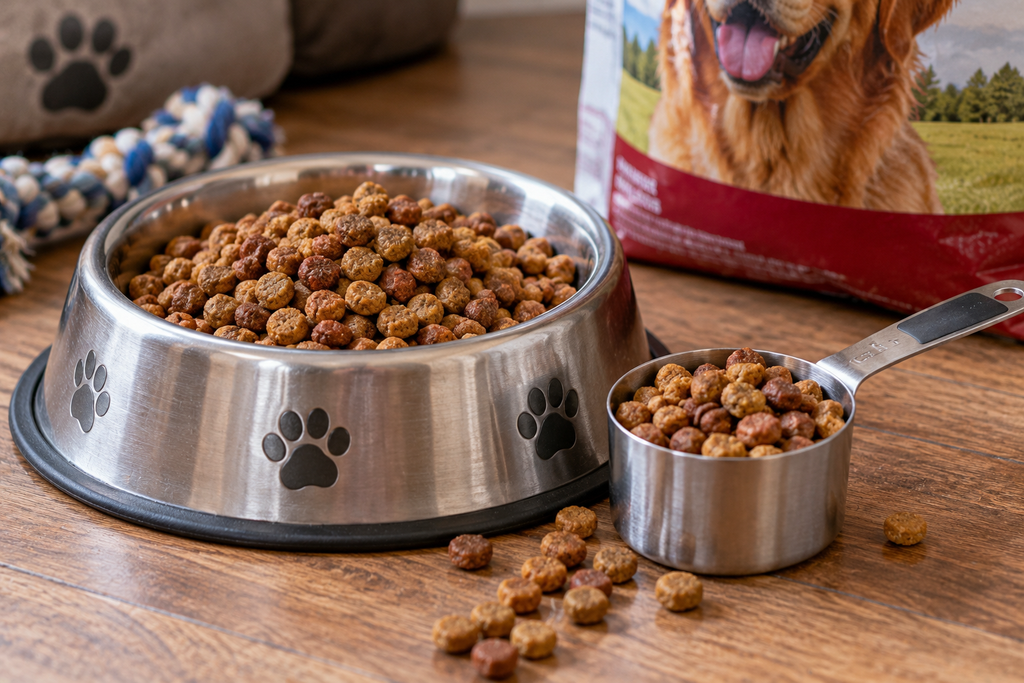
Multiply each dog’s measured daily ration by three, keeping the same unit throughout. A dog that eats 1½ cups of kibble per day needs 4½ cups for a three-day evacuation. Record that amount on the food bag or container so the packed supply can be checked at a glance. Repeat the calculation for each dog rather than combining their rations into one unlabeled total.
For canned food or pouches, calculate the three-day amount first, then round up to whole sealed packages. If a dog eats 1½ pouches per day, the calculation is 4½ pouches; pack five. That final half-pouch is part of the required three-day supply, not a bonus meal. Keep any feeding instructions with the packages if a meal uses only part of a can or pouch.
The three-day figure is the minimum to pack. A fourth day is an optional buffer, calculated by adding one more normal daily ration: the dog eating 1½ cups daily would need 6 cups total for four days. Label any extra separately so it does not obscure whether the required three days are already covered.
Match calories when packing a different food
A backup food may need a different-sized portion than the dog’s regular food. Use calories, not equal scoops or can counts, to calculate the three-day supply. Start with the calories in the dog’s established daily ration, then check the backup food’s label for kilocalories (kcal) per cup, can, pouch, or kilogram.
For example, a dog eating 720 kcal a day needs 2,160 kcal for three days. If the backup kibble contains 300 kcal per cup, that is 2.4 cups per day, or 7.2 cups total. If it comes in 240-kcal cans instead, the dog needs three cans a day—nine cans for three days. Round up when packing sealed containers, but label the daily portion so an opened package is not mistaken for one meal.
When the label lists only kcal per kilogram, calculate by weight: divide the daily calories by kcal/kg, then multiply by 1,000 to get grams per day. A kitchen scale makes this more reliable than estimating volume. Keep the label or a photo of its calorie information with the packed food so portions can be checked if someone else feeds the dog.
Packing the dog’s usual food avoids an abrupt change. For puppies, dogs that have not eaten the backup food, and dogs on medical diets, seek veterinary guidance before relying on a substitute. Matching calories does not make two foods nutritionally or medically interchangeable.
Pack and label each portion
Divide dry food into three labeled daily portions for each dog, or into individual meals if that makes feeding easier. Measure from the dog’s established ration rather than estimating by bag size. Seal each portion in a moisture-resistant bag, then place the bags in a sturdy, waterproof container. This makes the three-day supply easy to count without opening it.
Label every portion with the dog’s name, food brand and formula, amount, feeding time or frequency, and packed date. Keep the original package label or a clear photo of it so ingredients, lot number, and expiration date remain available if a recall or feeding question arises. Add written instructions for any food that must be given separately.
Leave wet food unopened until a meal is due. Pack enough cans or pouches to cover the calculated ration, plus a manual can opener if the cans lack pull tabs. Meal-sized containers are practical when refrigeration may be unavailable: opened wet food needs prompt refrigeration, and food left unrefrigerated for more than two hours should be discarded. Do not count on saving an opened can for the next meal at a shelter or in a vehicle.
Check packed dates and expiration dates during routine kit inspections. The emergency food rotation guidance explains how to replace aging portions without losing track of the three-day supply.
Pack water and feeding tools
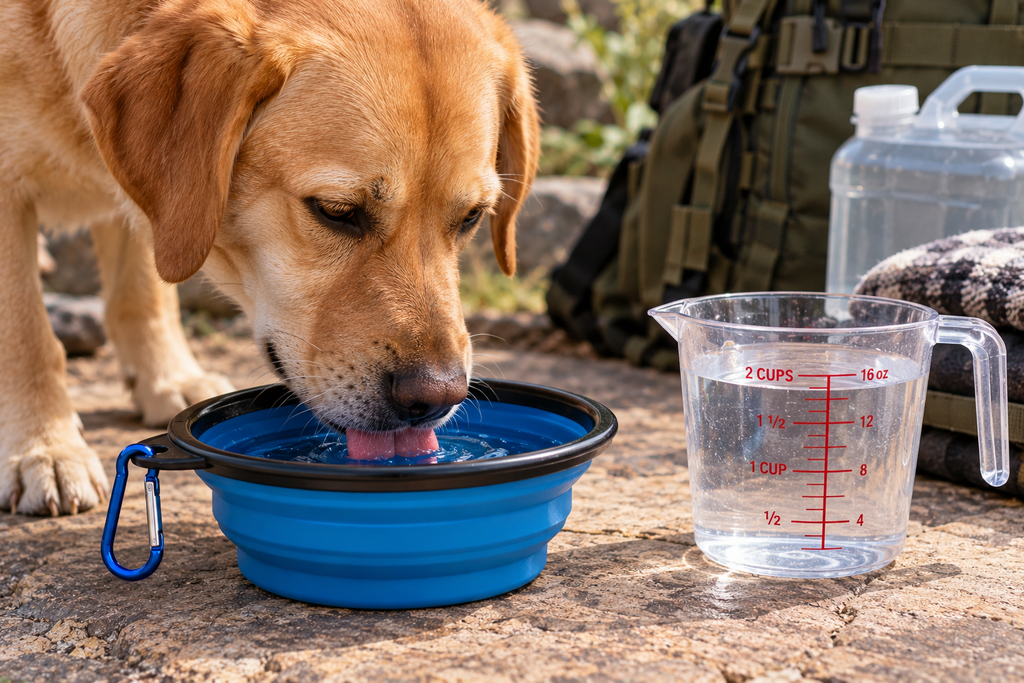
Drinking water needs its own calculation. As a starting point, allow about 1 ounce per pound of body weight per day, then adjust for heat, activity, illness, or veterinary instructions. A 40-pound dog, for example, needs roughly 120 ounces—just under a gallon—over three days. Use guidance on calculating an evacuation water supply to check the amount for each dog; dry food does not reduce the need for drinking water.
If a meal requires water to rehydrate it, read the package directions and multiply that amount by the number of packed meals. Add this to the drinking-water supply, rather than drawing it from the dog’s drinking allowance. Keep enough water accessible for the trip as well as the stay at a shelter or other destination.
Pack a food bowl, a water bowl, and a scoop or portion measure that matches the labeled meals. If the ration was measured by weight at home, measure one meal into the travel scoop and mark the fill line; scoop sizes alone do not guarantee the right portion. Place brief feeding instructions with the food: dog’s name, amount per meal, feeding times, and any rehydration directions. A caregiver should be able to serve a meal without searching for a scale, measuring cup, or instructions left at home.
Serve one meal using only the packed tools and instructions. Replace anything that is missing or unclear before sealing the kit.
Check the packed supply
Lay out one full day’s food for each dog as it would be served: every meal portion, plus any food reserved for medication. Use that lineup as a reference to check the evacuation supply. Each dog should have three complete, matching daily sets, not simply three bags or cans that look alike. If meals differ in size, verify each day’s breakfast and dinner separately.
Put the portions, water, bowls, opener, and any feeding instructions into the actual evacuation bag. Close it and lift it: a supply that fits only when left unpacked is not ready to leave. Place the bag beside the dog’s travel crate in the vehicle to check that both can be loaded without blocking access to either. If space is tight, choose a travel crate that fits the vehicle rather than assuming the bag can ride inside the crate.
Before storing the bag, check expiration dates and inspect seals for punctures, leaks, swelling, or loose closures. Mark a reminder to replace food before its earliest expiration date. Review the bag immediately whenever a dog’s diet, feeding schedule, or portion size changes; the old three-day count may no longer be accurate.
For each dog, fill in the measured ration: per day × 3 = minimum to pack. Keep the units consistent—cups, grams, cans, or pouches—and confirm that the packed meals add up to at least that amount. Add a fourth day only after all three days are covered.
Before closing the bag, check that each dog has clearly labeled meals, suitable food, and enough water for drinking and food preparation. Pack the bowl, measuring tool, and can opener needed to serve it. Feeding times and any special instructions should be legible so another caregiver can serve every meal without guessing.