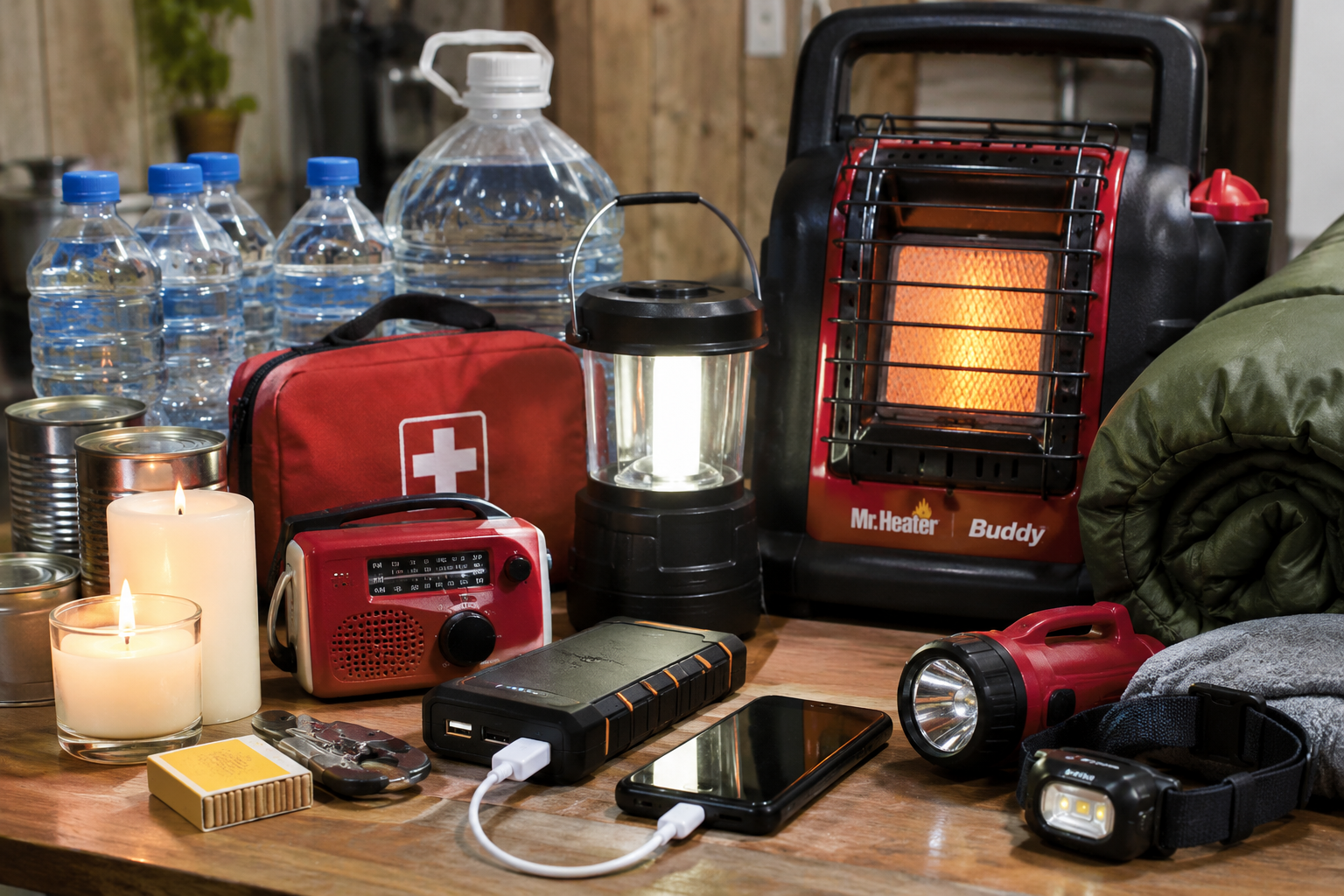
An emergency kit for a power outage is Ready.gov’s basic kit plus four things an outage adds: a light for each person, a way to charge phones, enough water, and no-cook food. For four people for three days, the priced items below come to about $295 at Walmart (October 2026), less whatever you already own. This is a buying guide, built from Ready.gov’s list and published specifications, not product tests. Once the lights go out, the first hour of an outage has its own steps, and those live on the power outage playbook.
We earn a commission when you buy through some links on this page. It does not change your price.
Match Your Power Outage Kit to What Stops Working
Every addition answers one thing the electricity runs. An outage turns off the lights, the outlets that charge your phone, the fridge and freezer, and, on a well, the water pump. The kit simply replaces each of those for a few days.
Most of the additions are small. A light for each person, a power bank, two appliance thermometers, and a cooler come to about $85 for a family of four at Walmart (October 2026), which is less than a third of the full list. Ready.gov notes that an outage may disrupt communications, water, and transportation; close retail stores, ATMs, and banks; cause food spoilage and water contamination; and prevent the use of medical devices. Each of those maps to a row in the kit: a radio and a charged phone, stored water, some cash, no-cook food and a cooler, and a plan for anyone who depends on a medical device.
Build the Power Outage Kit From Ready.gov’s List
Start with the 14 items Ready.gov lists for every home, then add the rows an outage calls for. The priced rows come to about $295 at Walmart (October 2026) for four people for three days: food is about $70 of that, and water about $14 to $18. The last three rows come from USDA FSIS and Ready.gov’s power outage guidance: keep an appliance thermometer in both the refrigerator and the freezer, have a large insulated cooler with frozen gel packs, and install a carbon monoxide alarm with battery backup on every level of the home. Ready.gov suggests storing the kit in airtight plastic bags inside one or two easy-to-carry containers. Keeping it fresh is section eight.
Costs at Walmart in October 2026, rounded. Household of four, three days.
| # | Item (official wording) | For four people, three days | Cost |
|---|---|---|---|
| 1 | Water, one gallon per person per day | 12 one-gallon jugs (section 3) | about $14 to $18 |
| 2 | Food, non-perishable | 3 days of no-cook food (section 6) | about $70 |
| 3 | Battery-powered or hand-crank radio and a NOAA Weather Radio with tone alert | one hand-crank radio with the NOAA weather band | about $25 |
| 4 | Flashlight | four 100-lumen headlamps, one each (section 4) | about $22 |
| 5 | First aid kit | one household kit, about 250 pieces | about $19 |
| 6 | Extra batteries | AA 24-pack, plus the size your lights take | about $10 |
| 7 | Whistle | one | about $3 |
| 8 | Dust mask | N95 masks, pack of 10 | about $20 |
| 9 | Plastic sheeting, scissors and duct tape | one roll of duct tape, sheeting, scissors | tape about $5, rest check price |
| 10 | Moist towelettes, garbage bags and plastic ties | 48 wipes, a box of bags, ties | wipes about $2, rest check price |
| 11 | Wrench or pliers | one, to turn off utilities | check price |
| 12 | Manual can opener | one | about $4 |
| 13 | Local maps | a paper map of your area | check price |
| 14 | Cell phone with chargers and a backup battery | 10,000 mAh power bank, car charger (section 5) | about $13 and about $10 |
| 15 | Appliance thermometers (USDA FSIS) | one for the fridge, one for the freezer | about $20 |
| 16 | Insulated cooler and frozen gel packs (USDA FSIS) | one 48-quart cooler | cooler about $28, gel packs check price |
| 17 | Carbon monoxide alarm with battery backup (Ready.gov) | one on each level of the home | about $25 each |
| 18 | Cash (Ready.gov) | small bills, an amount you choose | your amount |
| Priced rows, total | about $295 |
Cross off what you already own. Rows 15 to 17 come from USDA FSIS and Ready.gov’s Power Outages page; the rest are Ready.gov’s basic kit. The wipes, bags and ties in rows 9 and 10 have their own emergency sanitation supplies guide. You can match any row against today’s prepper deals before you buy, or build your household’s list with the kit builder.
How Much Water to Store for a Power Outage
Water is the first row and the heaviest. Ready.gov says to store at least one gallon per person per day, for drinking and sanitation, for at least three days, and to try for a two-week supply if you can. Two quarts a day is only half the official figure, so do not cut it there. Four people need 12 gallons for three days, and 56 gallons for two weeks.
Costs read at Walmart in October 2026. 12 gallons is four people for three days.
| Format | Per gallon | 12 gallons |
|---|---|---|
| One-gallon jugs | about $1.20 to $1.50 | about $14 to $18 |
| 24 bottles of 16.9 oz | about $1.25 | about $16 (4 packs) |
| 40 bottles of 16.9 oz | about $1.15 | about $18 (3 packs, about 16 gallons) |
Packs of 40 came to about $1.15 a gallon, compared with $1.20 to $1.50 for jugs, so two weeks for four (56 gallons) runs about $63 to $84, depending on the format you pick. The CDC calls unopened, commercially bottled water the safest and most reliable source in an emergency. If you bottle your own, use food-grade containers and replace the water every six months. The CDC also notes that children, nursing mothers, and sick people may need more water, and that in very hot weather, water needs can double. A deeper guide on storing water at home covers treating and rotating what you keep.
Choose Power Outage Lighting in Three Price Bands
Light is the first thing you reach for, so it gets the most choice. Ready.gov says to have a flashlight for every household member, which means four people need four lights before they need one very bright one. Four 100-lumen headlamps cost about $22 at Walmart (October 2026).
Costs at Walmart in October 2026, rounded. Lumens and run times as listed by the store.
| Band | Light | As listed | Cost |
|---|---|---|---|
| Under $10 | LED headlamp | 100 lumens, 3 AAA batteries included | about $6 |
| Under $10 | Mini LED lantern | 500 lumens, carabiner handle | about $5 |
| $10 to $30 | LED lantern, battery | 1,000 lumens, 5 modes, up to 75 hours | about $10 |
| $10 to $30 | Plug-in power failure night light | rechargeable, plug-in, switches on automatically, 3-in-1 | about $12 |
| $10 to $30 | Rechargeable headlamps, 2-pack | 6 modes including red light | about $17 |
| $10 to $30 | Rechargeable lantern with power bank | 1,000 lumens, USB-C power bank | about $21 |
| $30 and up | Rechargeable lantern | 3,000 lumens, USB-C charging, 4 modes | about $45 |
| $30 and up | Weather radio with light and power bank | NOAA alerts, solar and crank, 10,000 mAh power bank | about $100 |
The three bands sort themselves by the job each light does. Under $10 buys a headlamp or a small lantern. The $10 to $30 band includes a 1,000-lumen lantern, a plug-in power-failure light that switches on by itself when the power cuts, and rechargeable headlamps. The $ 30-and-up band is a 3,000-lumen lantern, or a weather radio that combines a light and a power bank.
A sensible plan for four is about $44: four headlamps (about $22), a battery lantern for the room you gather in (about $10), and a plug-in power failure light for the hallway (about $12). Give each light a job. A headlamp keeps your hands free for work. A lantern lights the room. A plug-in power failure light catches someone walking in the dark because it comes on by itself the moment the power cuts, as the store lists it. FEMA says not to use candles or open flames near anything flammable, and battery and rechargeable lights avoid that question entirely. Match the batteries while you shop: the headlamps take AAA, lanterns differ by model, so buy the spares from row six for your lights and keep anything rechargeable topped up.
How to Charge a Phone During a Power Outage
A phone is your radio, your flashlight, and the way you call family, so keeping it charged matters more than almost anything else in the kit. Ready.gov says to plan for batteries and other alternative power when the power goes out, such as a portable charger or power bank, and a 10,000 mAh power bank costs about $13 at Walmart (October 2026). Charge the power bank and the phone as soon as a storm is forecast, not after the lights are already off.
A car charger (about $10) works, but only with the car running outdoors. The CDC is blunt about this: never run a car or truck inside a garage, even with the garage door open. A generator will charge phones and run the fridge, and here too the CDC sets a hard rule: only use a generator outside, more than 20 feet from any window, door, or vent, and keep a battery-powered or battery-backup carbon monoxide detector inside the home (row 17). Many hand-crank radios list a USB port that can top up a phone, which published specifications describe as a slow trickle, a backup rather than a real charge.
I keep Jackery, Bluetti and EcoFlow power stations, a WEN generator and three emergency radios.
Ready.gov adds two things worth doing before the power even goes out: find out whether your home phone will still work in an outage and how long its battery backup lasts, and turn off or unplug appliances and electronics, because power can come back with a surge that damages them. Whether a power station can run a refrigerator depends on its rated watts and battery size, which is a longer conversation; for now, you can check today’s power station deals, or the Bluetti power stations page, when you are ready to buy.
Plan Power Outage Food Without Cooking or a Fridge
Food is the row that needs the least gear: three days, no stove. Ready.gov says to keep at least a several-day supply of non-perishable food, and for four people for three days, canned tuna and chicken, chili and soup eaten from the can, peanut butter, crackers, cereal, shelf-stable milk, applesauce cups, granola bars, raisins and trail mix come to about $70 at Walmart (October 2026).
Ready.gov notes that commercially canned food can be eaten straight from the can without warming, which is why the basket needs a manual can opener (row 12, about $4) and no stove at all. USDA FSIS gives the timing for what is already cold: the refrigerator keeps food safe for up to four hours, and a full freezer holds its temperature for about 48 hours, or 24 if it is half full. That is why the kit carries a cooler, gel packs, and two thermometers (rows 15 and 16) for the hours after. The thermometers watch the FSIS targets: the fridge at 40°F or below, the freezer at 0°F or below. A fuller keep-it-or-toss-it list lives on the power outage food page.
Fit the Power Outage Kit to Winter, Medicine and Pets
The table fits most homes, but a few needs change it. Ready.gov’s additional supplies list a sleeping bag or warm blanket for each person, prescription medications, infant formula and bottles, diapers, wipes and diaper rash cream, pet food and extra water for your pet, and cash or traveler’s checks. For a winter outage, it is the same kit plus a sleeping bag or warm blanket for each person; safe ways to heat a room are on the stay-warm page. When you add a row, add its cost from the same store and month as the main table so the numbers stay honest.
Medicine deserves its own plan. Ready.gov says to have alternate plans for refrigerating medicines or running power-dependent medical devices, and to talk to your medical provider about a power outage plan. If the power is out for more than a day, discard any medication that should be refrigerated, unless the drug’s label says otherwise, and ask your doctor or pharmacist for a new supply. Ready.gov also lists easy-to-forget extras: books, games, and puzzles for children; a full change of climate-appropriate clothing and sturdy shoes; a fire extinguisher; and matches in a waterproof container.
Check and Refresh the Power Outage Kit Twice a Year
A kit only works if it is still charged, still fresh, and somewhere everyone can find it. Check it twice a year, when the clocks change. The CDC says to check carbon monoxide detector batteries when you change your clocks each spring and fall, and to replace stored water every six months, so one habit covers both. The next two dates are Sunday 14 March 2027 and Sunday 7 November 2027. Re-read the costs at each check and update the date line above the table, since the cost column only helps while it is current.
At each check, charge the power bank and rechargeable lights, test the flashlights, and swap out any low batteries. Ready.gov says to keep canned food in a cool, dry place, store boxed food in tightly closed plastic or metal containers, replace expired items as needed, and re-think your needs every year. Keep the home kit in one designated place and make sure the whole family knows where it is; a car kit is separate. The CDC adds that a carbon monoxide detector should be replaced according to the manufacturer’s instructions, or every five years.
Get Answers to Common Power Outage Kit Questions
What are 10 items in an emergency kit?
Ready.gov lists water, non-perishable food, a crank or battery radio, a flashlight, a first aid kit, extra batteries, a whistle, a dust mask, a manual can opener, and a phone with chargers and a backup battery, among 14 items in all.
What should I stock up on for a power outage?
Water at one gallon per person per day for three days, food that needs no cooking, a light for each person, spare batteries, a charged power bank, a radio, and a carbon monoxide alarm with battery backup.
How much does a power outage kit cost?
For four people for three days, the items on this list cost about $295 at Walmart in October 2026. Subtract anything you already own from that total, and a light for each person starts at about $6.
Should I buy a ready-made power outage kit or build one?
Either works. Check a ready-made kit against Ready.gov’s list, especially one gallon of water per person per day and a light for each person. Building your own lets you skip whatever you already have.
Is there a device that turns on when the power goes out?
A plug-in power failure light stays in the outlet and switches on by itself when the power cuts, as the stores list them. One costs about $12 at Walmart in October 2026.
What do you need for a winter power outage?
The same kit plus a sleeping bag or warm blanket for each person (Ready.gov) and a carbon monoxide alarm with battery backup. Safe ways to heat a room are on the stay-warm page.
For more on getting ready before the next outage, see our emergency planning guides.
Obviously, where you live makes a huge difference in power needs. Some areas have severe winters; others have warm winters but a high risk of hurricanes. Use this information as best you can for your situation and your family’s needs. Stay comfortable, Diane