By Kay · Costs read November 7, 2026 (Updated November 18, 2026)
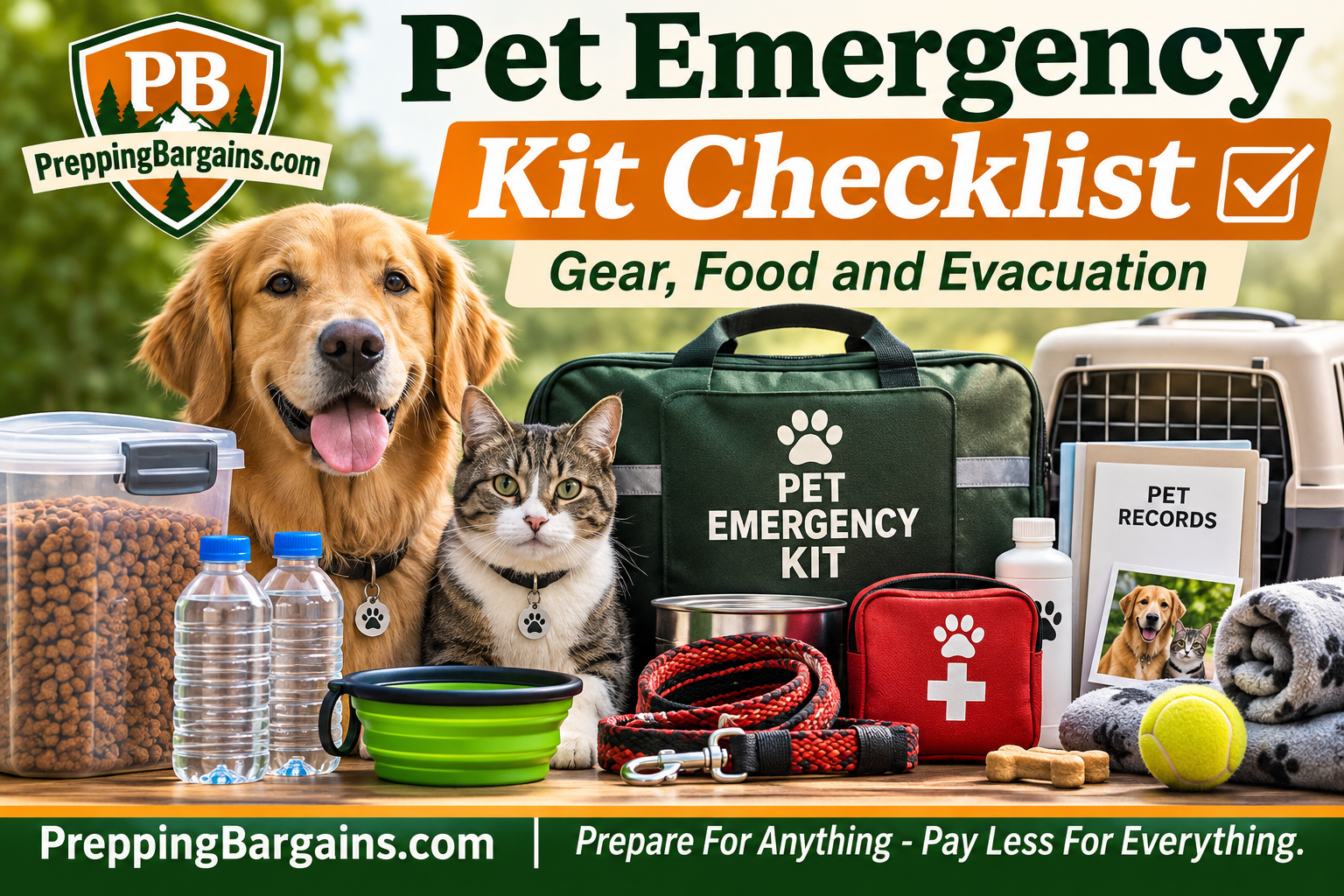
A pet emergency kit is the short list that leaves with your animal when you do: food and water, medicine, records, and a carrier. Ready.gov’s pet list is the backbone, and the AVMA puts real numbers on it: about 3 to 7 days of food, at least 7 days of water, and a two-week supply of any medicine. For one dog, the priced items below come to about $95 at Walmart as of October 2026, less whatever you already own. This is a buying guide built from Ready.gov’s and the AVMA’s lists, not a product test. Keep the kit by the door you would actually leave from.
Disclosure: We earn a commission when you buy through some links on this page. It does not change your price.
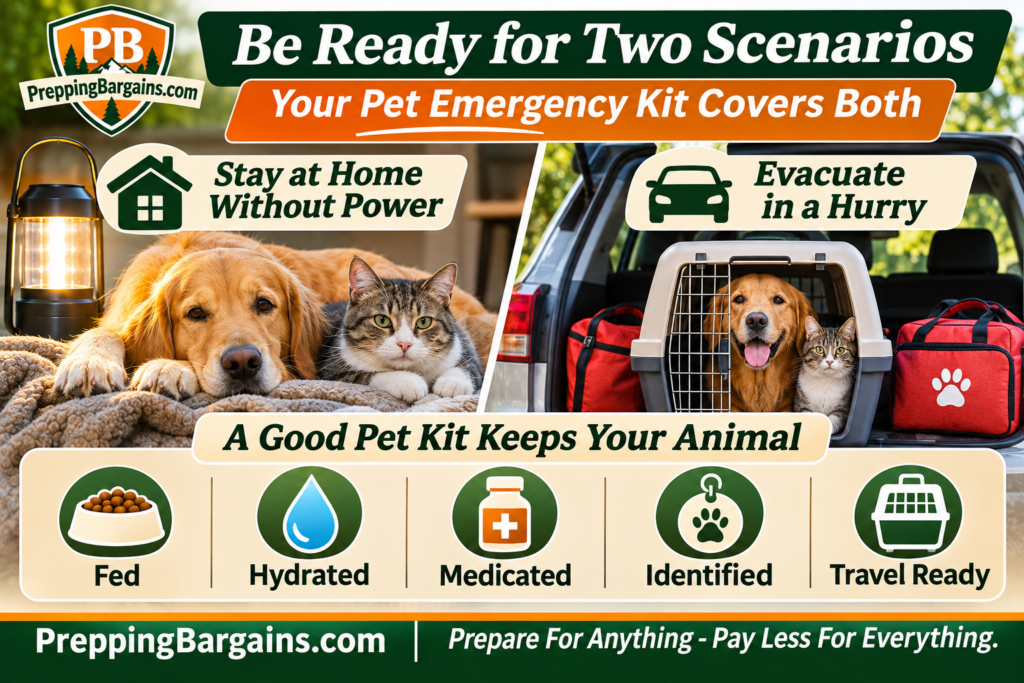
Match Your Pet Kit to What an Emergency Changes
A pet kit answers two questions: can your animal stay, and can it leave? An emergency usually does one of two things. It keeps you home without power, or it sends you out the door in a hurry. A good kit covers both, so your animal can eat, drink, stay identified, and travel for several days either way.
Ready.gov builds its whole plan around three simple parts you can hold in your head: make a plan, build a kit, and stay informed. This page is the kit. The AVMA frames it around leaving, and that framing is worth borrowing: assemble the kit well in advance, and store it in an easy-to-carry, waterproof container kept close to an exit. Pack it once while things are calm, and you are not digging through cabinets while the lights flicker.
Build the Pet Kit From Ready.gov’s List
Start with the items Ready.gov lists for every pet. The list is short enough to shop in one trip, and I have put each item next to what to buy for one dog, and about what it costs, so you see a real number instead of guessing. Cross off anything you already own; most people have the bowl, the leash, and a spare blanket before they start.
One note on prices: I read these on a single day at one store, so treat them as a planning figure and check the date line above the table. Where a row points to Amazon, it says to check today’s price there rather than printing a number, since those move often. If you want to build the medical side yourself, check our What Goes in a Dog First Aid Kit guide. Make your pet first aid kit specific to your pet and their needs and preferences.
Costs read at Walmart on November 18, 2026, rounded. One dog, several days.
| # | Item (Ready.gov’s wording) | What to buy, one dog | Cost (Nov 18, 2026) |
| 1 | Food: ‘keep several days’ supply’ | 3 to 7 days of the food your pet eats (see next section) | about $18 |
| 2 | Water, and ‘a water bowl to use’ | 7+ days at your pet’s daily need, plus a collapsible bowl | about $8 |
| 3 | ‘Airtight, waterproof container’ for food | One lidded food tub | about $9 |
| 4 | Medicine, ‘in a waterproof container’ | Two-week supply plus a small dry box | check price |
| 5 | First aid kit ‘appropriate for your pet’ | A pet first aid kit | about $15 |
| 6 | ‘Backup collar with ID tag and a harness or leash’ | Spare collar, ID tag, and leash | about $12 |
| 7 | Records ‘in a waterproof container and available electronically’ | A document sleeve, plus a phone photo of each | about $3 |
| 8 | ‘Traveling bag, crate or sturdy carrier for each pet’ | One carrier sized to your pet | about $25 |
| 9 | Grooming items: ‘pet shampoo and other items’ | Travel pet wipes and a small shampoo | about $5 |
| 10 | ‘A picture of you and your pet together’ | A printed photo for the records sleeve | from home |
| 11 | Sanitation: ‘pet litter and litter box, trash bags’ | Waste bags (dog) or a travel litter tray (cat) | about $4 |
| 12 | ‘Familiar items’: ‘favorite toys, treats or bedding’ | One toy, a few treats, a blanket | check price |
| 13 | Carrier ‘labeled with your contact information’ (AVMA) | A luggage tag for the carrier | about $2 |
| 14 | Microchip up to date (Ready.gov) | No cost if already chipped; a vet visit if not | no cost |
Cross off what you already own. Rows 1 to 3, 6 to 9, and 11 to 12 are Ready.gov’s basic pet kit; the day-counts in rows 1, 2, and 4 are the AVMA’s. Shopping today? See today’s prepper deals.
For one dog, the priced rows come to about $95 at Walmart as of October 2026, and the carrier is the single biggest line.
How Much Pet Food and Water to Store
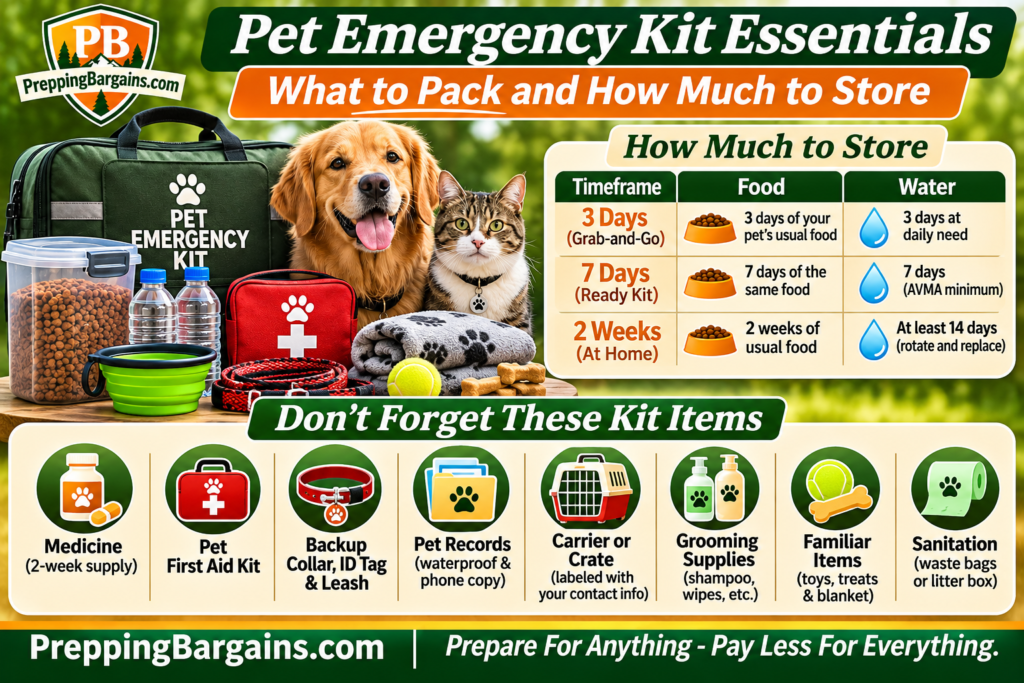
Ready.gov says ‘several days.’ The AVMA says how many, and the answer is friendlier than you would expect. Ready.gov tells you to keep several days’ supply of both food and water, and to store the food in an airtight, waterproof container. The AVMA puts figures on it: 3 to 7 days’ worth of food, at least 7 days’ supply of water, and a reminder to rotate and replace these so nothing expires. Not sure how much food to take with you. Check out this How Much Dog Food to Pack for a 3-Day Evacuation guide.
Start at 3 days you can grab and carry, then build toward 2 weeks at home as your budget allows. Your pet does not need special emergency rations; their normal food, sealed and rotated, is exactly right. For water, a common rule of thumb is about one ounce per pound of body weight a day, so a 40-pound dog drinks close to 40 ounces on a calm day, and more when it is hot or stressful. Round up, and store that water on top of the one gallon per person a day you keep for the people in the house.
| How long | Food to store | Water to store |
| 3 days (grab-and-go) | 3 days of your pet’s usual food | 3 days at your pet’s daily need |
| 7 days (ready kit) | 7 days of the same food | 7 days, the AVMA’s minimum |
| 2 weeks (at home) | Up to 14 days as budget allows | 14 days at your pet’s daily need |
If your pet has a health condition, ask your vet what to adjust before you settle on a number.
Pack Your Pet’s Medicine and Records
Two things are easy to forget and hard to replace: the medicine and the paperwork. Start with medicine. Ready.gov says to keep an extra supply of the medicine your pet takes regularly in a waterproof container, and the AVMA recommends a two-week supply. Keep it a few days ahead of each refill so the kit is never the reason you run short. I am not going to name a medication or a dose here; that is your vet’s call, and ‘the medicine your pet takes’ is the only instruction that fits every animal.
The paperwork does the quiet, important work of proving an animal is yours and reuniting you if you are ever separated.
- Proof of ownership and records. The AVMA names vaccination records, medical records, and proof of ownership. Keep them together in a document sleeve.
- Paper and digital, both. Ready.gov says to keep copies in a waterproof container and available electronically, so photograph each page to your phone.
- A current photo of the two of you. It quietly proves the pet is yours, and it helps anyone who finds them reach you faster.
- Microchip, up to date. A chip only helps if the number on file reaches you, so confirm your contact details with the registry.
When you reach a shelter, knowing what records to bring to a shelter saves a frantic hour. Find the emergency shelter pet paperwork guide here.
Choose a Carrier and Keep Your Pet Calm
The carrier only helps if your pet will get in it, and you can find it. Two quiet failures trip people up: the carrier is buried in a closet, or the pet has never been inside it and panics at the worst moment. The AVMA’s advice solves both. Store the kit, including the carrier, close to an exit, and label the carrier with your contact information. Ready.gov recommends a travel bag, crate, or sturdy carrier for each pet, plus familiar items that reduce stress.
- A blanket that smells like home. Familiar scent calms a stressed animal faster than anything you can buy.
- One favorite toy or chew. Small comfort, and a big difference in a noisy, unfamiliar place.
- A worn shirt of yours. For cats especially, your scent marks the safe spot in the carrier.
The AVMA adds one step most people skip: practice evacuating with all your pets and their supplies, so the real day is a repeat, not a first try.
Decide to Evacuate With Your Pet or Shelter in Place
Find a pet-friendly place before you need one, because the hardest part is deciding in the moment. Ready.gov is blunt about why: many public shelters and hotels do not allow pets inside, so know a safe place you can take your pets before an emergency happens. That might be a pet-friendly hotel two towns over, a relative’s house, or a boarding kennel outside the likely trouble area. The AVMA puts it the same way: locate and pre-arrange an evacuation site that sits outside the impacted area.
Then build yourself a backup. Ready.gov recommends a buddy system, planning with neighbors, friends, or relatives so someone can care for or evacuate your pets if you cannot get home in time. The rule I follow is simple: if a place is not safe for you, it is not safe for them, so the plan is always to take them with you. Decide now who grabs the carrier and who grabs the leash, and the scramble becomes routine.
Check and Refresh the Pet Kit Twice a Year
A kit only helps if the food is still good and the papers are still current. No ranking page bothers to tell you this, and it is the step that keeps the kit real. The AVMA says kit supplies must be rotated and replaced so they do not expire, which means food, water, and medicine all have a shelf life you need to watch.
Tie the check to something you already do twice a year: the clock change. The next two dates are Sunday, March 14, 2027 and Sunday, November 7, 2027. When you change the clocks, open the bin, swap anything near its date, top off the water, and confirm the phone number on the ID tag and the microchip registry is still one you answer. Ten minutes, twice a year, and the kit is always ready.
Common Pet Emergency Kit Questions
What Should Be in a Pet Emergency Kit?
Ready.gov’s list covers it: several days of food and water, medicine, a pet first aid kit, a spare collar with ID and a leash, records, a carrier, grooming and sanitation items, and a familiar toy or blanket.
How Much Food and Water Should I Store for My Pet?
The AVMA says 3 to 7 days of food, at least 7 days of water, and a two-week supply of any medicine. Rotate all three so nothing expires, and store more at home as your budget allows.
How Much Does a Pet Emergency Kit Cost?
For one dog, the priced items in this list came to about $95 at Walmart in October 2026. Anything you already own, like the bowl or the leash, comes right off that total.
Can I Take My Pet to an Emergency Shelter?
Not always. Many public shelters and hotels do not allow pets, so Ready.gov says to line up a pet-friendly place and a buddy before a disaster, and to plan on taking your pet with you.
What Papers Do I Need to Evacuate With a Pet?
The AVMA names vaccination records, medical records, and proof of ownership, plus your pet’s microchip number. Keep one copy on paper in a waterproof sleeve and one copy on your phone. Check our guide to what paperwork you need to take to a shelter for you and your pet.
Do I Need a Kit for a Cat as Well as a Dog?
Yes. It is the same list, sized per animal, with a carrier for each one and a small travel litter tray in place of a dog’s waste bags. A stressed cat hides, so a familiar blanket matters even more.
Want more like this? See our other emergency planning guides.