By Diane, November 21, 2026
Part of our American Preparedness Statistics 2027 report.
When the water stops flowing, most households find out fast how many ordinary things depend on a reliable supply. Drinking is only the start. Cooking, brushing teeth, washing hands, preparing food, caring for pets, and managing some medical needs all take water. So the practical question is not just how many gallons to buy. It is how much your household may need, how long you want to manage without normal service, whether the water will stay safe, and how you will reach it and replace it.
The Centers for Disease Control and Prevention (CDC) recommends storing at least one gallon of water per person per day for three days, and trying for a two-week supply if you can. That is a planning benchmark, not a measurement of what American households actually keep on hand. The American Preparedness Statistics 2027 research review did not find a reliable current national estimate of household emergency-water storage. This guide turns the official benchmark into household-size examples, explains when you may need more, and covers the storage and safety decisions that make a supply genuinely useful.
How Much Water to Store Per Person
The CDC’s June 27, 2025 guidance recommends at least one gallon per person per day for three days, and says households should try to store a two-week supply if possible. It describes that water as being available for drinking, cooking, brushing teeth, and other uses. The phrase “at least” is doing real work here. One gallon is a starting point, not a guarantee that it covers every household’s full needs. The amount can run higher in hot climates and for pregnant people, people who are sick, and pets, and your activities, medical needs, and sanitation setup all affect it too.
Quick Household Water Calculations
Use the one-gallon-per-person-per-day benchmark to estimate a starting quantity: multiply the number of people by the number of days you want to cover. The figures below are arithmetic from the CDC benchmark, with the two-week column as the CDC’s suggested goal if possible. Individual needs may be higher.
| Household size | 3-day supply | 14-day supply |
|---|---|---|
| 1 person | 3 gallons | 14 gallons |
| 2 people | 6 gallons | 28 gallons |
| 4 people | 12 gallons | 56 gallons |
| 6 people | 18 gallons | 84 gallons |
For a four-person household, that is 12 gallons for three days and 56 gallons for 14 days. These are calculations from the CDC benchmark, not a separate CDC estimate of what every four-person household will need. A 28-day figure would be 112 gallons for four people, but that is just the same one-gallon formula extended, not a CDC recommendation. If you plan for a longer stretch, weigh your household’s real uses, your storage capacity, and your ability to replenish.
Why One Gallon Per Person May Not Be Enough
Water needs vary. A household with infants, someone who is ill, a pregnant person, pets, or people living in a hot environment may need more than the basic math, and the amount also depends on what you expect the stored water to cover. A gallon per person per day is not a complete sanitation and hygiene plan. Drinking, cooking, and basic personal needs are not the same as water for every shower, laundry load, toilet flush, or cleanup, so if a disruption drags on, plan separately for sanitation and other non-drinking uses. Think about what is specific to your household:
- Infants and young children, including the water that formula preparation takes.
- Pregnant people and anyone who is sick or recovering.
- People taking medication or managing a condition that affects fluid needs; follow their clinician’s advice.
- Pets, with amounts suited to the animal, its size, activity, and conditions.
- Hot weather, strenuous activity, or a home without reliable cooling.
- Household members with disabilities or mobility limits who may need water in accessible containers.
Do not let a general online calculation override medical advice. Anyone with fluid restrictions or other medical considerations should ask their health care professional what is right for them.
A Water Plan Is More Than a Gallon Count
The research review treats household water preparedness as several connected decisions: quantity, safety, access, and replenishment. Think of it as a practical framework for planning, not a federal score or a survey measure.

1. Quantity: How Much Do You Need?
Start with the number of people who may be home and the duration you want to cover. Then adjust for pets, special needs, hot conditions, and the activities your supply has to support. If you are planning for a longer disruption, ask whether that amount is realistic to store, physically and financially, and how you would add to it over time.
2. Safety: Is the Water Suitable for Its Use?
Water that looks clear is not automatically safe to drink. Stored water has to be protected from contamination, and water collected from another source may need treatment, with the right treatment depending on what might be in it.
3. Access: Can Everyone Get to It?
A big barrel in the basement looks like a lot of water, but it is no help if people cannot reach it, lift the containers, or dispense it safely. Think about container size, weight, and location, taps or spigots, and the needs of children, older adults, and people with disabilities.
4. Replenishment: What If the Disruption Continues?
Stored water buys your household a buffer. It does not guarantee you can manage a long disruption indefinitely. Consider how you would learn whether local service is safe again, where you could get more water, and how you would carry it if normal services were down.
Choosing and Storing Emergency Water
Commercially Bottled Water
The CDC calls unopened, commercially bottled water the safest and most reliable emergency source. Keep it in its original sealed container, follow the product’s date and storage instructions, and protect it from heat, direct sunlight, and chemicals.
Filling Your Own Containers
If you fill containers yourself, use food-grade water-storage containers. The CDC advises choosing containers made for drinking-water storage and contacting the manufacturer if you are not sure a container is food-grade. Never reuse a container that held fuel, pesticides, cleaning chemicals, or other toxic substances; one that looks clean can still hold residues that make water unsafe. Avoid glass, which can break, and pick a container that closes tightly.
The CDC’s instructions for home-filled water include washing and sanitizing the container before you fill it. Label each one as drinking water and record the date you filled it. Store it in a cool place, which the CDC puts at 50°F to 70°F, away from direct sunlight and from toxic substances such as gasoline or pesticides. The CDC recommends replacing home-filled water every six months. For commercially bottled water, follow the date and storage instructions on the original container.
Think About Container Size and Total Weight
Water is heavy. One U.S. gallon weighs about 8.3 pounds before you add the container, so a 14-day supply for four people at one gallon per person per day, which is 56 gallons, comes to roughly 465 pounds of water alone. That is not a reason to give up on the goal. It is a reason to plan storage realistically. Smaller containers are easier to move and share out, while large ones get hard to handle when full. Think about the floor, the shelving, the route you would carry it, and whether people in the home can safely lift or dispense it. For large quantities, do not assume an upper floor or shelf can hold the load without checking its capacity.
What If Your Home Uses a Private Well?
A private well usually depends on an electric pump, so if the power goes out, the water can stop even when the well itself is fine. The specifics depend on your well system, pump, and any installed storage or backup. Households on wells should learn how their system works before an emergency. Ask a qualified well professional what happens during a power interruption, whether the system has a safe backup option, and how to protect the well and plumbing after flooding or other contamination risk. Do not assume water from a flooded or damaged well is safe because it looks clear; follow your local health department or state well-water program on testing, disinfection, and when the water is usable again.
Municipal Water Interruptions and Drinking-Water Advisories
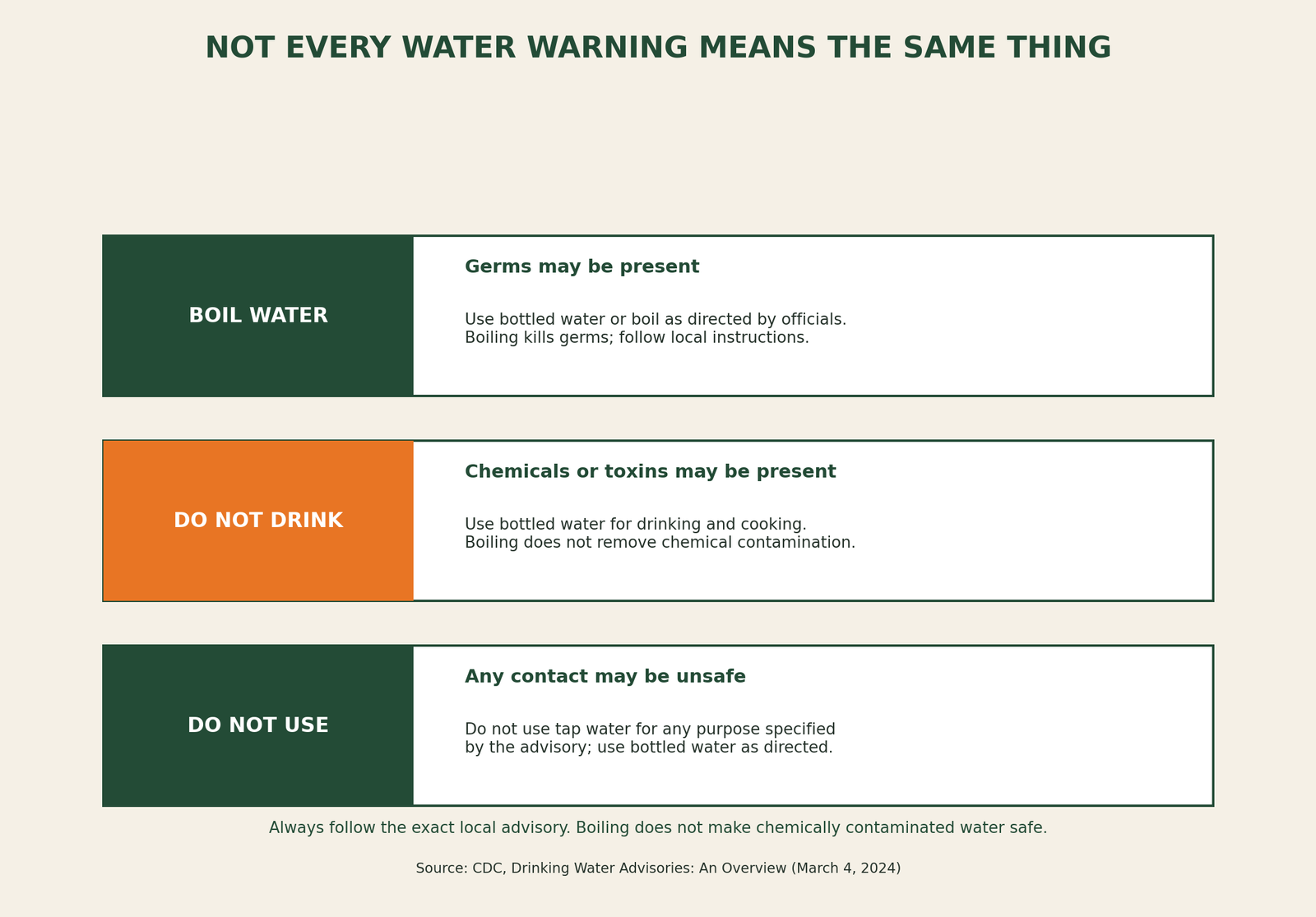
A municipal disruption can mean different problems. A water main break or power failure can cut service. A contamination event can leave water running from the tap but unsafe for some or all uses. Those situations do not share one solution. When officials issue a drinking-water advisory, read the exact notice and follow local instructions. The CDC describes three types.
Boil Water Advisory
A boil-water advisory generally goes out when harmful germs may be present. Officials usually tell people to use bottled water or boil tap water as directed. CDC guidance says to bring clear water to a rolling boil for one minute, or three minutes at elevations above 6,500 feet. Boiling is meant to kill disease-causing organisms. It does not remove harmful chemicals, toxins, or radioactive materials.
Do Not Drink Advisory
A do-not-drink advisory may be issued when chemicals or toxins could make swallowing the water unsafe. Boiling does not make chemically contaminated water safe. Use commercially bottled water for the purposes the advisory specifies, and follow local directions for cooking, brushing teeth, food preparation, pets, and other uses.
Do Not Use Advisory
A do-not-use advisory means contact with the tap water may be dangerous. Follow the instructions exactly; the notice may rule out drinking, cooking, bathing, or other contact. Use bottled water or another source as officials direct. And do not assume a household filter, pitcher, camping filter, or countertop device can strip out every contaminant. Filters are built for particular contaminants and conditions, so check the exact product certification and instructions and follow the local advisory. If officials say not to use the water, do not try to make it safe with an ordinary household filter.
Rainwater, Streams, and Other Alternative Sources
Rain barrels, ponds, streams, and other nearby sources can look like convenient backups, but water from them should not be treated as drinking water by default. It can carry germs, chemicals, or other contaminants from roofs, soil, runoff, animals, storage equipment, or the surrounding area. Boiling or disinfecting handles certain biological hazards, but it does not remove many chemicals, heavy metals, salts, or other contaminants. The EPA specifically warns that boiling or disinfection will not destroy contaminants such as heavy metals, salts, and most chemicals, so if fuel or toxic chemicals may be present, use bottled water or another source authorities have identified as safe. Rainwater collection can be useful for some non-potable purposes where local rules and system design allow, but do not count it as drinking water unless it has been collected, treated, and tested with a method matched to the contaminants that may be present. A general-purpose filter is not a universal fix.
How to Build Your Household Water Plan
You do not have to buy a giant tank all at once. Start with a clear target and build a supply you can actually maintain.
- Count the people and pets who may depend on the household supply.
- Figure a three-day starting quantity at one gallon per person per day, then set a longer-term target. The CDC suggests trying for two weeks if possible.
- Add capacity for hot weather, illness, pregnancy, pets, and other household-specific needs.
- Choose safe, food-grade containers in sizes people can reach and handle.
- Pick a cool, protected spot away from sunlight, fuel, pesticides, and other contaminants.
- Label home-filled containers with the contents and fill date, and replace home-filled water every six months.
- Plan for private-well or municipal dependencies, including power loss and contamination notices.
- Decide how you will get more safe water if the disruption outlasts your supply.
- Keep current water-utility, health-department, and well-service contacts with your emergency plan.
Review the plan when household size, health needs, pets, living arrangements, or water systems change. A stored supply that no one can reach, or that no one knows how to use safely, is not a complete plan.
The Goal Is a Usable Supply, Not Just a Number
The one-gallon benchmark gives you a practical place to begin, and a two-week target adds a bigger buffer when space and budget allow. But the right plan weighs more than volume. The water has to be safe, reachable, suited to your household, and replaceable if normal service stays down. Start with the people and animals who depend on you, calculate a realistic first target, and choose containers and a storage spot you can maintain. Then make sure everyone knows the difference between a service interruption, a boil-water advisory, and a chemical contamination warning. Emergency water planning is not about guessing how long a disaster will last. It is about giving your household more options when the tap is dry, or when what comes out of it cannot be trusted.
More From the Preparedness Report
- Growing Food for Household Security
- How to Prepare for a Two-Week Power Outage
- How to Prepare Your Pets for a Disaster
Related tool: Put your own household numbers in with our Food Storage Calculator, which works out how much food and water to keep on hand.
Sources and Further Reading
- Centers for Disease Control and Prevention. “How to Create an Emergency Water Supply.” June 27, 2025.
- Centers for Disease Control and Prevention. “Drinking Water Advisories: An Overview.” March 4, 2024.
- Centers for Disease Control and Prevention. “How to Make Water Safe in an Emergency.” September 19, 2024.
- U.S. Environmental Protection Agency. “Emergency Disinfection of Drinking Water.”
- U.S. Environmental Protection Agency. “Water Decontamination Frequently Asked Questions for Customers.”
- PreppingBargains.com. American Preparedness Statistics 2027, Chapter 10, Emergency Water.