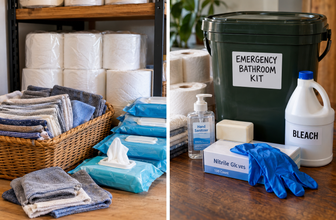
Remember spring 2020, when the toilet paper aisle looked like a scene from a disaster movie? People stacked rolls to the ceiling while their neighbors went without. Here is the part nobody mentioned during the panic: the average American burns through about 30 rolls a year. Roughly 70 percent of the world does not use toilet paper at all. If you want a soft, living backup growing in your own yard, this covers which plants actually work, how to grow and multiply them, and how to keep a stash for winter.
We will start with a little history, because it makes the whole idea feel a lot less strange.
A Quick, Slightly Awkward History
Wiping with a leaf sounds primitive until you realize modern toilet paper is actually a new invention. Your great-great-grandparents almost certainly never used it.
People managed for thousands of years with whatever was close by. The first recorded use of paper for the job shows up in 6th-century China. Wealthy Romans had something stranger, a sea sponge on a stick called a tersorium. Rinsed in vinegar or salt water and, a little alarmingly, shared with others. Some historians now argue that sponge may have been a toilet brush rather than a wiper, which tells you how murky the record gets.
Out on American farms, the options were earthier. Dried corncobs were the workhorse, kept on a string in the outhouse. Then came free paper. Households hung the Sears catalog and last year’s Farmers’ Almanac on a nail and worked through the pages. Sears even got complaints when it switched to glossy stock in the 1930s, because the slick paper no longer did the job. Commercial rolls did not really take over until the early 1900s, and splinter-free paper arrived later still. Leaves, by comparison, are the oldest and softest answer we have.
What Makes A Leaf Safe To Use
Before you go grabbing greenery, a word of caution. That is sensitive skin back there, and the wrong leaf can turn a minor inconvenience into a genuinely rotten week. Poison ivy in that region is the stuff of camping legend horror stories for a reason.
So be picky. You are looking for a few simple traits.
- Soft or fuzzy surface. Fine hairs are what make a leaf feel like cloth instead of sandpaper.
- Broad and roomy. Big enough that one or two leaves finish the job.
- Absorbent but sturdy. It should hold up without shredding the moment it touches down.
- Smooth edges. Skip anything with jagged or spiny margins.
Steer clear of anything waxy, glossy, or unfamiliar. Trying a new plant? Rub a leaf on your inner wrist and wait 24 hours. If your skin stays calm, it is safe for more delicate territory. One more thing, and it matters: none of these are flushable, so bury or compost them.
A handful of plants deserve a hard pass, and a few of them look soft enough to fool you:
- Poison ivy, oak, and sumac. The classic offenders. Their urushiol oil causes a miserable rash, and it clings to the leaves even in the off season.
- Stinging nettle and wood nettle. The fine hairs inject an instant burning sting, and they are easy to grab by accident when you are reaching in a hurry.
- Sycamore. Those big leaves tempt you, but the fuzz on the underside rubs off into a fine dust that irritates skin and airways.
- Comfrey. It reads like a big, soft, fuzzy leaf, yet the coarse bristly hairs are scratchy and leave sensitive skin unhappy.
- Giant hogweed, wild parsnip, and cow parsnip. Their sap can blister skin once it hits sunlight, so skip these tall, umbrella-flowered plants entirely.
The Plants Worth Growing
You do not need a rare specimen or a greenhouse for any of this. The best options are common, tough, and probably sitting at your local nursery right now. Here are the ones I would actually plant.
Lamb’s Ear, My Top Pick
If you grow only one plant off this list, make it lamb’s ear (Stachys byzantina). The leaves are silver-green, thick, and coated in fine hairs that feel closer to velvet than a leaf has any right to. Most mature leaves run over 4 inches, so a couple will do. It is non-toxic, and it comes with a useful side history. Old-timers called it woundwort and pressed the leaves onto cuts and bee stings, since the plant has mild antiseptic properties.
It is also easy it is to grow. Lamb’s ear is hardy in USDA zones 4 through 8, loves full sun, and honestly prefers poor, dry, well-drained soil. It laughs off drought. Through a mild Southern winter, like ours here in Arkansas, it often holds its leaves as a low, semi-evergreen mat, which is exactly what you want for a year-round supply. If you can track down the cultivar ‘Helene von Stein’, sometimes sold as ‘Big Ears’, grab it. The leaves are larger, it shrugs off summer heat, and it rarely bothers to flower, so the plant pours its energy into foliage instead.
- Pick a sunny, well-drained spot. Full sun keeps the leaves silver and dense. Soggy ground is the one thing it will not forgive.
- Set plants about 12 to 18 inches apart. They spread into a mat, so give them room to fill in.
- Water them in, then ease off. Once established, an inch of water a week is plenty, and less when the weather is cool.
- Skip the rich soil and heavy mulch. Lean ground and airflow keep it healthy. Mulch piled on the crown just invites rot.
Mullein, The Wild Classic
Mullein (Verbascum thapsus) is the plant old cowboys reached for, and the nickname cowboy toilet paper stuck for good reason. In its first year it forms a rosette of huge, flannel-soft leaves, some over a foot long. In year two it launches a flower spike that can climb 5 to 10 feet, crowded with yellow blooms. It grows from seed, thrives on neglect, and is happiest in poor, sunny, gravelly ground where little else wants to live.
Now for the good-news, bad-news part. The bad news is that mullein is a champion self-seeder. A single plant can drop hundreds of thousands of long-lived seeds, which is why a handful of states list it as a noxious weed. (Also could be good news for a big family that needs a lot). The good news is that this same toughness is why so many preppers already grow it on purpose, mostly for its long history in herbal remedies, and why it turns up growing wild along roadsides and field edges where you can harvest it for free. If you do plant it, clip the flower spike before it sets seed and you keep the whole thing in bounds.
When you harvest from a wild plant, take only a leaf or two from each healthy rosette and leave the rest to keep growing. And squeeze a leaf before you use it. That releases a little of the plant’s natural compounds and softens the fuzz even more.

Grape Leaves, The Common Forager’s Pick
Grape leaves (Vitis spp.) show up on these lists for good reason. Each leaf runs about the size of a toilet paper square, they hold up without tearing, and wild grapes sprawl across fence lines and woodland edges in much of the country. They are not plush like lamb’s ear. What they offer instead is size and sturdiness, plus a bonus: the young leaves are edible, which is why Greek cooks have wrapped rice in them for centuries. If you already grow grapes, you have a supply on hand. A vine trained up a trellis throws off far more leaves than you will ever use, and old homesteaders used to plant one right by the outhouse for exactly that reason.
Here is the catch, and it is worth taking seriously. Wild grape has a poisonous look-alike called Canada moonseed. You are picking leaves rather than eating berries, but pressing a toxic plant against sensitive skin is a bad trade, so learn the two quick tells before you forage.
- Check the leaf edge. True grape leaves have a jagged, toothed margin. Moonseed leaves are smooth-edged, with no teeth.
- Check for tendrils. Grapevines climb with curly, forked tendrils. Moonseed has none and simply twines its stem around a support.
When those two tells do not both point to grape, leave it be. That habit keeps foraging the calm, useful skill it should be.
A Few More Worth Knowing
Depending on where you live, a few other soft-leaved plants are worth locating or tucking into a bed.
- Blue spur flower (Plectranthus barbatus). Once planted right beside outhouses for convenience. It roots easily from cuttings, smells minty, and suits warm climates or life as a houseplant.
- Thimbleberry (Rubus parviflorus). A native shrub with soft, hand-sized leaves. A great option if you are up in the Pacific Northwest or the northern woods.
- Big leaf aster (Eurybia macrophylla). Nicknamed lumberjack’s toilet paper, with broad, sturdy leaves that handle shade well.
- Broadleaf plantain (Plantago major). The humble lawn weed. Not the softest of the bunch, but it grows almost everywhere and doubles as nature’s band-aid.
- Borage (Borago officinalis). A fuzzy-leaved garden herb with blue star flowers the bees adore. Stick to the young leaves, because older ones turn bristly and scratchy as the plant matures.
Trees With Leaves Big Enough For The Job
Do not overlook the canopy. A couple of common trees carry leaves so large and soft that people have wiped with them for generations, and a single leaf covers what would take a fistful of lamb’s ear. These are the original Dude Wipes. The trade-off with trees is seasonal. You get leaves from spring through fall and nothing once they drop, so treat these as a warm-weather bonus rather than a year-round plan.

Catalpa, The Toilet Paper Tree
Down South, the catalpa (Catalpa speciosa and Catalpa bignonioides) earns the nickname toilet paper tree, and the leaves explain why. They are heart-shaped, run 6 to 12 inches long, and the undersides carry a soft coat of fine hairs. Catalpa is native, grows fast, and throws heavy shade, so it earns its keep in the yard long before you ever consider its bathroom résumé. You will know it by the long, dangling seed pods that give it another nickname, the cigar tree. Another bonus with Catalpa are Catalpa worms that are a favorite bait of catfish.
It is not a tidy tree. The pods and big leaves make a mess, and it will seed itself around if you let it. None of that is a dealbreaker for a shade tree you also plan to harvest from. Pick the fully expanded leaves in summer, and turn the softer, fuzzier underside toward your skin.
Empress Tree, Big Leaves With A Big Caveat
If you have ever seen a young tree with leaves the size of dinner plates, velvety on both sides, it was probably an empress tree, also sold as princess tree or royal paulownia (Paulownia tomentosa). Cut it back hard and the fresh shoots push out leaves up to 16 inches across. As a wiping leaf, it is honestly tough to beat: soft, broad, and forgiving.
Here is the big caveat, and for you it lands close to home. Paulownia is an aggressive invasive across the South, it’s filed under invasive trash tree. It grows on brittle wood and seeds by the thousands on the wind, then sprouts back from the roots faster than you can dig it out. So I would not plant one. The good news is that you rarely need to, since it has naturalized along roadsides, fence lines, and disturbed ground almost everywhere. Harvest from a wild one and you get those giant soft leaves without turning it loose in your own yard.
A Bonus Use: Emergency Bandages
Here is a happy coincidence. The same soft, fuzzy leaves that work as toilet paper also make a passable emergency bandage, and for the same reason. That velvety fuzz soaks up moisture. If a scrape or a bee sting catches you far from your first aid kit, a couple of these plants can hold you over. I do want to be clear about one thing, this is old-fashioned field first aid for minor stuff. A deep cut or anything serious still needs a real bandage and, when it matters, a doctor.
A few of them earn a spot in a first aid pinch:
- Lamb’s ear. The standout. Herbalists nicknamed it woundwort, and its absorbent leaves soak up blood and help it clot while offering mild antibacterial and anti-inflammatory properties. Soldiers used it as a field dressing as recently as the American Civil War.
- Broadleaf plantain. Nature’s band-aid. Crush a clean leaf into a rough poultice and press it on a sting or scrape to calm the itch and cover the spot.
- Mullein. Those big flannel leaves have a long folk history as poultice wraps, handy when you need something broad to cover a wider scrape.
To use one, pick a clean leaf, bruise it gently to release its compounds, lay it over the spot, and hold it in place with a strip of cloth or even a long blade of grass. Rinse the wound first if you have clean water. And skip anything you cannot identify with confidence, because the whole point is to help, not to trade one problem for a fresh rash.

How To Propagate For A Steady Supply
One plant is a novelty. A patch is a supply. The nice thing about these plants is that they practically multiply themselves, so a small starter investment turns into all the soft leaves you will ever need.
Lamb’s ear is the easiest to bulk up, and division is the trick. Every three or four years the middle of an old clump gets crowded and a bit tired. Splitting it refreshes the plant and hands you free copies at the same time.
- Dig up a mature clump in spring or fall. Lift the whole thing with a garden fork so you keep as many roots as you can.
- Pull or cut it into sections. Each piece needs some roots and a few leaves. Even a 6-inch rooted chunk will take hold.
- Replant right away. Space the divisions like new plants and firm the soil gently around them.
- Water them in. Keep them damp for a couple of weeks while they settle, then treat them as established plants.
Mullein and plantain do the work for you by self-seeding, and blue spur flower roots from a simple cutting stuck in soil. Truth is, the hardest part of propagating any of these is deciding where to put all the extras.
Feeding For More Leaves
Nitrogen is the nutrient that drives leafy, green growth, so it is tempting to feed these plants hard and harvest a jungle. I would resist that urge for most of these suggested plants. Here is the catch. Lamb’s ear and mullein evolved on lean, rocky ground, and too much nitrogen pushes soft, floppy, overcrowded growth that loses its silver color and rots in humid weather. You can end up with more leaves that are actually worse to use.
A lighter hand works better. A thin topdressing of compost in spring, or a single diluted feeding, gives you fresh growth without wrecking the plant’s character. Full sun and good drainage do more for these plants than any bag of fertilizer ever will. Two free tricks help just as much:
- Harvest the outer leaves. Picking from the outside edge signals the plant to push new growth from the center.
- Pinch off flower stalks. On lamb’s ear especially, stopping the bloom redirects that energy straight back into leaves.
Winter Supply And Storage
Most of these plants take the winter off. Mullein dies back to a low rosette or disappears entirely, and lamb’s ear slows way down, though in a mild zone it often keeps enough semi-evergreen leaves to limp through. Come a hard freeze, you are out of fresh leaves until spring, so a little planning in late summer pays off.
Drying is the simplest way to build a cold-weather stash. Harvest healthy leaves before the first frost and dry them flat, then store them somewhere out of the damp.
- Pick clean, unblemished leaves in late summer. Take them before cold weather knocks the plants back.
- Dry them flat. Lay them in a single layer out of direct sun until they feel papery.
- Stack and store somewhere dry. A paper bag, a shoebox, or an old tin all work fine. Label it so nobody grabs it by mistake.
Be honest with yourself about the trade-off. Dried leaves turn brittle and tear more easily than fresh ones, and they give up some of their absorbency. The upside is that a bit of moisture on contact softens them back up. Handle them gently, keep a backup of the ordinary soft-cloth kind on hand too, and you are covered until the garden wakes up in spring.
Final Thoughts
Think back to those bare shelves in 2020. The people who stayed calmest were not the ones with a basement wall of rolls. They were the ones who knew they had options. You do not need to hoard anything when a soft, silver patch of lamb’s ear is quietly multiplying by the back fence. Plant a little this year, let it spread, and the next shortage becomes somebody else’s problem to panic over.