By Diane, who runs Prepping Bargains and reads every price herself.
We earn a commission if you buy through links on this page. It does not change your price.
Walk into prepping cold and the internet will try to sell you a $400 survival kit before you have bought your first gallon of water. That pressure is the real budget killer, not the gear. The fix is the order you buy in: water first, then food, then the few tools that let you open a can and see in the dark. On this page I give you that order, step by step, with what each piece costs at Walmart right now and a running total you can trust. You can start this month, with the cash you already have.
The short version is that the government’s own two-week food and water minimum for one adult comes to about $70 at Walmart, and a fuller kit lands near $135. Here is how to get there without a panic purchase, with help from the Prepping Bargains deals for preparedness on a budget.

Start With What You Already Have
Before you spend a dollar, shop your own house. Most of us already own more preparedness than we think, and finding it is free. Walk through the kitchen, the bathroom, the garage and the car, and write down what is already on hand.
- Water and food: bottled water, canned goods, dried pasta and rice, and anything shelf stable you already rotate.
- Light and power: flashlights, a camp lantern, spare batteries, a phone power bank.
- Warmth and tools: extra blankets, a tarp, matches, a lighter, a basic first aid box.
Write it all down so you do not buy it twice. That list is your real starting point, and it costs nothing.
Skills are free too. A library book or a low-cost first aid class adds real readiness without adding a thing to your cart. The point of the inventory is simple: spend only on the gaps, not on what you already own.

The Order to Buy In, and Why
The order matters more than the brand. You can live only days without water, so it comes first. Food is next, then the few tools that make your food and your warnings usable, then first aid and sanitation. That is not my opinion. It mirrors the official emergency kit, so each step maps to a named standard.
Ready.gov’s Build A Kit list is the backbone here: water, food, a radio, a flashlight, a first aid kit, extra batteries, a whistle, a manual can opener, local maps, a phone and charger, and sanitation supplies. If you want a full household version with costs, I keep one in the Emergency Kit Builder.
- Water first: you need it every day, and you cannot make much of it at home.
- Food second: cheap calories you already eat, stored to last.
- Open it and see it: a manual can opener, a light and spare batteries.
- Hear the warning: a hand-crank or weather radio for when the power is out.
- First aid and sanitation: the rest of the official kit, bought once food and water are set.

Step 1, Water: Two Weeks for the Price of the Containers
Store one gallon per person per day. Ready.gov puts the minimum at three days, which is three gallons per person, and suggests two weeks at home, which is fourteen gallons per person. Children, nursing mothers, sick people and hot climates need more. The good news: tap water is free, so you are really just paying for the containers.
A sturdy 7-gallon container is listed at about $20 at Walmart, so two of them cover one adult for two weeks for about $40. Fill them from the tap and write the date on the side. There is no need to buy cases of bottled water.
Water need from Ready.gov (one gallon per person per day, two weeks at home). Container price listed at Walmart, read November 12, 2026. Re-read the week you publish.
| Household | 3-day water | 2-week water | 7-gal containers | Listed at Walmart, Nov 2026 |
|---|---|---|---|---|
| 1 adult | 3 gallons | 14 gallons | 2 | about $40 |
| Family of 4 | 12 gallons | 56 gallons | 8 | about $160, or use larger barrels |
One note that trips people up: the common “store 14 gallons” rule is per person. A family of four needs about 56 gallons for two weeks, so larger barrels start to make sense.
Two habits keep stored water safe. Refresh tap water about every six months, and keep it somewhere cool and dark. If you ever need to stretch your supply, a personal filter such as a LifeStraw or a Sawyer runs under $30 and cleans water you find, a cheap backup to what you store.

Step 2, Food: Rice, Beans and Peanut Butter Carry the Calories
Three plain staples do most of the work. Twenty pounds of rice, twenty pounds of pinto beans and a 40-ounce jar of peanut butter give you about 75,000 calories, roughly a month at 2,000 calories a day for one adult, for about $30 at Walmart. That alone clears the government’s two-week food minimum with room to spare.
Calories from USDA FoodData Central; prices listed at Walmart, read November 12, 2026. Re-read the week you publish.
| Staple | Size | Listed at Walmart, Nov 2026 | Approx calories |
|---|---|---|---|
| Long grain white rice | 20 lb | about $11 | about 32,000 |
| Dried pinto beans | 20 lb | about $15 | about 30,000 |
| Creamy peanut butter | 40 oz | about $4 | about 15,000 |
| Core total | about $30 | about 75,000 (about a month at 2,000 a day) |
Round it out with a few cans you will actually eat. Canned beans run about 86 cents a can and a 4-pack of chunk light tuna about $3, so a little ready-to-eat protein is cheap. Store what your household already likes, and rotate it so nothing goes to waste.
For the long haul, a little packaging goes a long way. Dry staples sealed in Mylar bags with oxygen absorbers, then tucked into a food-grade bucket, keep for years instead of months. Add a bottle of multivitamins so a plain rice-and-beans stretch still covers the basics, and keep a little variety so meals do not get grim.
To size a full two-week supply for your own household, run the numbers through the Food Storage Calculator. It turns “two weeks for a family of four” into a real shopping list.
Step 3, Open It and See It: Can Opener, Light and Batteries
A pantry of cans is no good if you cannot open it, and a dark house is its own problem. A few dollars fixes both.
- Manual can opener: listed at about $3 at Walmart. Buy one even if your power rarely goes out.
- A light per two people: a mini LED flashlight is about $2, and a brighter 550-lumen one about $10. Ready.gov suggests one flashlight for every two people.
- Spare batteries: pick one common size and buy lights and a radio that all use it, so one pack runs everything.
That last tip saves real money and real headaches. Matching battery types means you are not hunting for an odd size in the dark.
Step 4, Radio, First Aid and Sanitation
With water and food set, round out the official kit. A hand-crank or NOAA weather radio lets you hear warnings when the power is down, and a hand-crank model needs no stored batteries at all. Add a basic first aid kit and simple sanitation supplies.
- Weather radio: a hand-crank or NOAA alert radio, about $20 to $30. Check the current price the week you buy.
- First aid kit: a basic kit runs about $10 to $15, or build your own from bulk supplies.
- Sanitation: bleach, trash bags, and moist towelettes, around $10 together.
- Anyone who needs it: prescription medicine, infant formula and diapers, and pet food, a three-day supply at least.
What It Costs All Together: A Running Total to Two Weeks Ready
Here is the whole thing in buy order, with a running total. For one adult, the water and food core is about $70, and the fuller kit comes in at about $135. That beats the loose “$155 to $250 per adult” figure you will see repeated online, because it is itemized and dated.
One adult, two-week goal. Prices listed at Walmart, read November 12, 2026. Three rows marked “check price” are read the week you publish. One date at the top of the table covers the table.
| Step | Buy | Listed at Walmart, Nov 2026 | Running total |
|---|---|---|---|
| 1 Water | Two 7-gallon containers, filled from the tap | about $40 | about $40 |
| 2 Food | Rice 20 lb, pinto beans 20 lb, peanut butter 40 oz | about $30 | about $70 |
| 3 Open and see | Manual can opener, LED flashlight, spare batteries | about $8 | about $78 |
| Ready to eat | Canned tuna and a few canned beans | about $7 | about $85 |
| 4 Radio | Hand-crank or NOAA weather radio | check price (about $20 to $30) | about $110 |
| 5 First aid | Basic first aid kit | check price (about $10 to $15) | about $125 |
| 6 Sanitation | Bleach, trash bags, moist towelettes | check price (about $10) | about $135 |
Scale it for a bigger household by adding water containers first, then more of the same cheap staples. The order does not change.
Where to Save and Where Not To
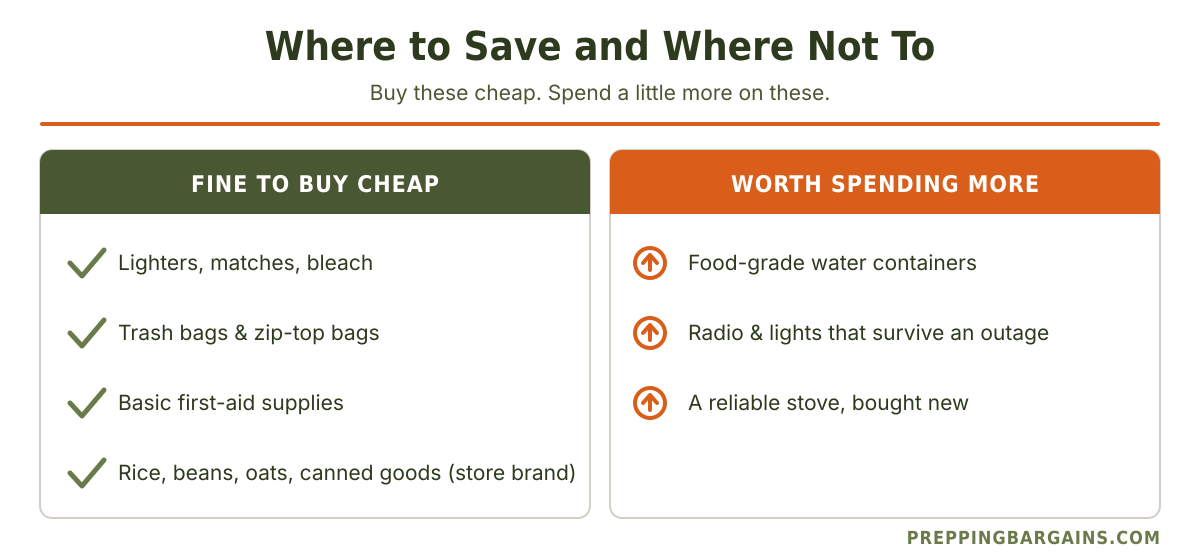
Real savings come from patience, not hype. Some things are safe to buy cheap, and a few are worth doing once and doing right.
Fine to buy cheap:
- Dollar-store wins: lighters, matches, bleach, trash bags, zip-top bags and basic first aid supplies all do the job.
- Commodities: rice, beans, oats and canned goods, where the store brand is as good as the name.
Worth spending a little more:
- Water containers: a jug that cracks loses your water and your money. Buy food-grade containers once.
- Your radio and lights: gear that dies in an outage is worse than plain gear that works. Do not cut here.
A cheap stove that quits in a storm costs more than a plain, reliable one bought new. Count storage, rotation and safety before you call something a bargain.
Here is how a patient stack adds up. On a regional sale you might combine a store coupon, a loyalty discount and a rebate on food-storage tubs, and watch the price slide from about $25 a tub to roughly $16. That saved $9 buys most of a month of rice. That is the kind of stack I watch for so you do not have to hunt alone.
Build It Over Time: A Month-by-Month Plan on a Set Budget
You do not buy all of this at once. Set a small monthly amount and follow the order. At about $25 a month, one adult reaches the two-week mark in roughly six months. At $50 a month, about three. The trick is to buy this month’s step even in a quiet month.
A $25-a-month example for one adult. Figures from the running total above. Re-read the week you publish.
| Month | Step | About cost | Running total |
|---|---|---|---|
| 1 | Water containers | $40 | $40 |
| 2 | Rice, beans, peanut butter | $30 | $70 |
| 3 | Can opener, light, canned protein | $15 | $85 |
| 4 | Hand-crank or NOAA radio | $25 | $110 |
| 5 | First aid kit | $15 | $125 |
| 6 | Sanitation supplies | $10 | $135 |
One warning worth repeating: more gear is not more readiness. A cabinet of a dozen different meal kits looks stocked, but if half expire before you rotate them, that money is gone. Match what you buy to your real risks and your household, and keep the plan simple enough to actually follow.
Then set a quarterly check: look at the dates, notice what you actually used, and replace it. Spreading the cost this way avoids wasting a full kit bought in one overwhelmed afternoon.
Get Answers to Common Prepping on a Budget Questions
What should I buy first when prepping on a budget?
Water, then food. You can live only days without water, so three gallons per person covers the three-day minimum and fourteen covers two weeks at home. Shelf-stable food your family will actually eat comes next.
How much does a two-week supply cost?
For one adult, the water and food core is about $70 at Walmart as of November 2026, and a fuller kit with a radio, first aid, and sanitation lands near $135. Prices change, so check them the week you buy.
Is dollar-store prepping worth it?
For some things, yes. Lighters, matches, bleach, trash bags and basic first aid supplies all perform well. Skip the dollar store for water containers or anything safety-critical, where a failure costs you more than you saved.
How do I prep with almost no money?
Shop your own home first, then add one cheap staple a week: a bag of rice, a few cans, a jug of water. Small and steady beats a big one-time cart every time.
How much water should I store?
One gallon per person per day. That is three gallons per person for three days, and fourteen for two weeks at home. Store more for children, nursing mothers, the sick, or a hot climate.
Hand-picked prepper deals, free every day.
Start This Month
Nobody gets ready in one shopping trip, and the people selling you that idea are the ones to trust least. Start with water and a monthly amount you can keep. Buy boring, reliable gear, rotate what you store, and let the order carry you from a starter shelf to real depth. When you are ready to stretch each dollar further, I round up the current prepping deals for you, so you are not hunting alone. You can start today, with what you already have.
Start looking around and using a little imagination, and you can save a lot of money,
Diane.